Videos -Japonesita comiéndose un pulpo-
Published Thursday, March 15, 2007 by Spyder.
El DSM-IV es la cuarta edición del Manual diagnóstico y estadístico de los trastornos mentales de la American Psychiatric Association. En este libro se especifican ocho tipos de parafilias típicas y otras siete no especificiadas.
PARAFILIAS (DSM IV)
Fetichismo; Fetichismo transvestista; Exhibicionismo; Voyeurismo; Pedofilia; Masoquismo sexual; Sadismo sexual; Frotteurismo; Parafilias no especificadas (Escatología telefónica; Parcialismo; Zoofilia; Coprofilia; Clismafilia; Urofilia).
Miro también en este listado mucho más extenso, donde se especifican sobre unas doscientas extrañas parafilias. Pero me sorprende, no encuentro ninguna referencia a tentáculos o a pulpos.
¿Y entonces que diablos es esto?


No lo sé, pero mola un mazo... ¿Estaremos más enfermos que los propios enfermos?
El video de la japonesita jalándose el pulpo se puede ver entero en el siguiente link: Japanese girl licking octopus
PARAFILIAS (DSM IV)
Fetichismo; Fetichismo transvestista; Exhibicionismo; Voyeurismo; Pedofilia; Masoquismo sexual; Sadismo sexual; Frotteurismo; Parafilias no especificadas (Escatología telefónica; Parcialismo; Zoofilia; Coprofilia; Clismafilia; Urofilia).
Miro también en este listado mucho más extenso, donde se especifican sobre unas doscientas extrañas parafilias. Pero me sorprende, no encuentro ninguna referencia a tentáculos o a pulpos.
¿Y entonces que diablos es esto?
No lo sé, pero mola un mazo... ¿Estaremos más enfermos que los propios enfermos?
El video de la japonesita jalándose el pulpo se puede ver entero en el siguiente link: Japanese girl licking octopus
Erotismo con pulpos -Tanga pulpero-
Published Thursday, November 23, 2006 by Spyder.
Espectacular. En aux2sous se puede encontrar lencería erótica, y por 4 euros uno puede comprar un tanga pulpero. Ninguna duda sobre la calidad de la modelo, aunque sí sobre la calidad del tejido del tanga.

Labels: Erotismo
Erotismo y pulpos -Chris Devera-
Published Saturday, November 11, 2006 by Spyder.
Al más puro estilo Hokusai, tenemos esta ilustración del artista norteamericano Chris Devera que lleva el título de Speaking tongues (que si nadie me desmiente vendría a ser algo así como lenguas habladoras). ¿Tiene el pulpo lengua? Esta duda existencial que me acaba de asaltar, creo que me impedirá esta noche dormir tranquilamente.
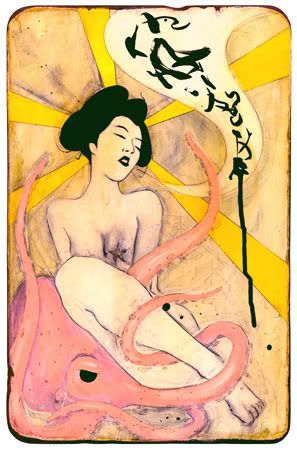
Para visitar la página del artista: aquí.
Conviene no pasar por alto la propuesta que hace Chris para pintarte desnudo o desnuda (igual hasta tiene un pulpo en su congelador dispuesto para posar contigo).
Labels: Erotismo
Erotismo con pulpos -Kevin Hundsnurscher-
Published Monday, March 20, 2006 by Spyder.
Para ver todo el fetichismo que ofrece Kevin Hundsnurscher en sus fotografías eróticas, visitar su página personal.

Kevin Hundsnurscher
Kevin Hundsnurscher
"I live in Seattle and I take all of my pictures here in the Seattle area. I don't think many people immediately think of fetish when they think of Seattle. In reality there is quite a thriving underground subculture living here. I just happened to be able to slip my way in to capture it all on film.
I've talked to a lot of other photographers and they all seem to be interested in what kind of camera I use, film and so forth. While technical aspects are important, I really don't try and concentrate too much on it. I usually just try and get a shot of the models when they're at their most natural and sexiest. A lot of times I'll track down a girl at a club and ask if I can take her picture; then go on down the street, get a couple of shots and then come back to the club to do it all again. It's not like I have a makeup artist there to help out or lighting rig of some sort. I usually catch them after they've been dancing all night."
Labels: Erotismo
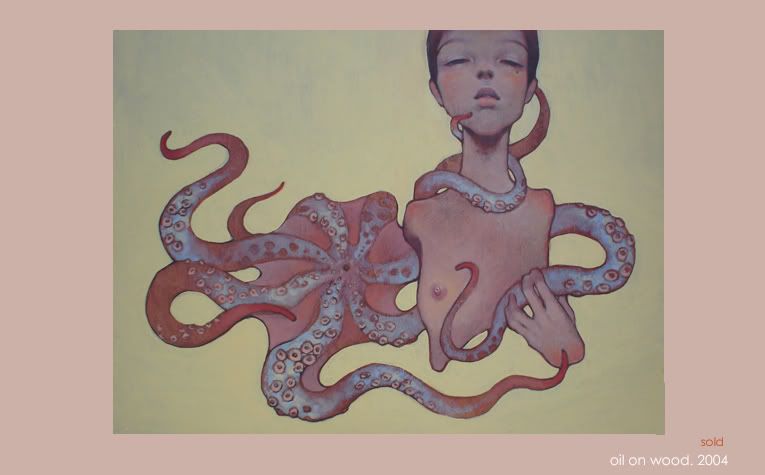
Erotismo con pulpos -Audrey Kawasaki-
Published Monday, March 06, 2006 by Spyder.
Hentai tentacular -Tentacle rape-
Published Thursday, November 03, 2005 by Spyder.
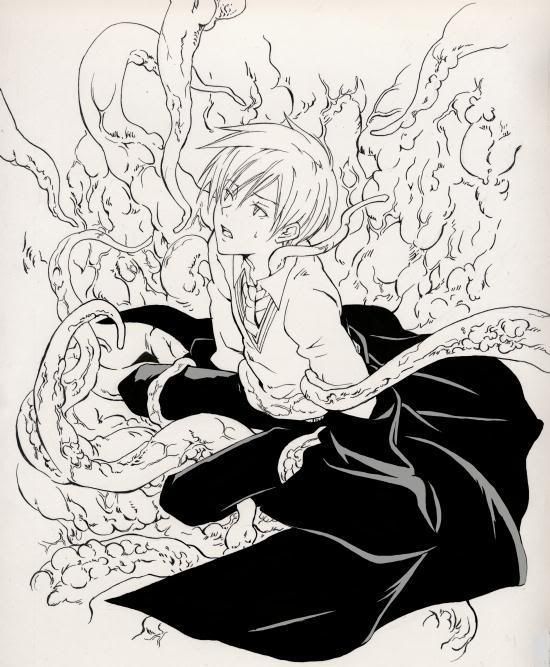
Si dentro de sus parafilias está la octofilia, tal vez les interese este artículo de la wikipedia, sobre las violaciones tentaculares tan comunes en el hentai japonés.
Tentacle rape
Vía Wikipedia
Tentacle rape is a concept found in some horror hentai titles, where various tentacled creatures (usually fictional monsters) rape or otherwise penetrate young, big-breasted women (or, less commonly, men). Much of the genre also consists of domination/humiliation and bondage fetishes, since the "victim" is typically restrained by the appendages. Biological justifications are sometimes given; the tentacle creature may be described as a parasite who deposits its eggs into a female for breeding. In other unlikely scenarios the creature outright impregnates its victim.
Tentacled creatures appeared in Japanese erotica long before animated pornography; among the most famous of the early instances (and perhaps the first) is a Hokusai (the original creator of the word manga) woodcut called The Dream of the Fisherman's Wife, depicting a woman sexually entwined with a pair of octopuses. This woodcut arose in the Edo period in Japan when Shinto was making a resurgence; the resulting animism and a more playful attitude to sexuality combined powerfully in Hokusai's piece. It is a celebrated example of shunga and has been reworked by a number of artists. Australian artist David Laity reworked the woodcut into a painting of the same name, and Masami Teraoka brought the image up to date with his 2001 work "Sarah and Octopus/Seventh Heaven", part of his Waves and Plagues collection.
Another example of pre-animation tentacle porn is the 1933 sci-fi short story "Shambleau" by author C.L._Moore. While the creature in the story is more vampiric than licentious, the elements of the narrative would be recognizable to anyone familiar with the genre.
Toshio Maeda's manga Urotsukidoji created what might be called the "modern paradigm" of tentacle porn, in which the elements of sexual assault are emphasized. Maeda explained that he invented the practice to get around strict Japanese censorship regulations, which prohibit the depiction of the penis but apparently do not prohibit showing sexual penetration by a tentacle or similar (often robotic) appendage.
Examples include:
The Urotsukidoji Saga — Started in 1987, the Overfiend series is the most well-known title in the genre.
La Blue Girl — a series of films that moved from animation to live action. Famous for being refused translation outright by the British censor.
Injukyoshi ("Obscene Beast Teacher") — a live action film.
Alien from the Darkness and Advancer Tina — Hentai films about female explorers battling tentacled aliens.
At times, the genre also seems to exploit the more controversial realms of bodice ripper genre, particularly rape fantasies, with the "safety" that the scenes being depicted are so absurd or fanciful they do not have parallels in the real world. Some fans see it as the extreme of bodice-ripping stories, although the rape fantasy genre is seen more critically in the West than in native Japan.
The topic is also ripe for parody, as shown by the following:
alt.sex.cthulhu and a range of other Cthulhu-related web pages
Many different web comics and cultural groups on the internet reference "tentacle pr0n" in a humorous way. An example is Ghastly's Ghastly Comic, in which it is a frequently recurring topic.
"The Lighter Side of Tentacle Hentai", from Sexy Losers
Hentai tentacular
Published Thursday, October 27, 2005 by Spyder.
Si ustedes han tenido la oportunidad de ver una película japonesa pornográfica editada para el mercado japonés se habrán dado cuenta con asombro que los primeros planos de los aparatos genitales quedan siempre difuminados con una mancha borrosa. Ocurre ello por un extraño sentido de la censura del país nipón que pese a permitir el consumo de películas o revistas pornográficas, éstas quedan totalmente “capadas”-
Esto también ocurre en los hentai (dibujos manga de alto contenido erótico), donde tampoco es demasiado bien visto el dibujo explícito de penes o de vello púbico. Sin embargo hecha la ley, hecha la trampa, y rápidamente un ejército de demonios tentaculares comenzaron a aparecer en los hentai y popularizarse entre esos lectores de manga. Los monstruos tentaculares de esta manera fueron ganando su espacio en el hentai, y además dieron rienda suelta a una serie de fantasía sexuales que siempre estuvieron presentes: la mujer dominada, la mujer penetrada por todos los lados (pues tentáculos nunca tienen por qué faltar), la mujer violada etc...

Via Wikipedia
Esto también ocurre en los hentai (dibujos manga de alto contenido erótico), donde tampoco es demasiado bien visto el dibujo explícito de penes o de vello púbico. Sin embargo hecha la ley, hecha la trampa, y rápidamente un ejército de demonios tentaculares comenzaron a aparecer en los hentai y popularizarse entre esos lectores de manga. Los monstruos tentaculares de esta manera fueron ganando su espacio en el hentai, y además dieron rienda suelta a una serie de fantasía sexuales que siempre estuvieron presentes: la mujer dominada, la mujer penetrada por todos los lados (pues tentáculos nunca tienen por qué faltar), la mujer violada etc...
Via Wikipedia
Legislación japonesa
El artículo 175 del código penal japonés prohíbe la publicación de material "moralmente perjudicial", que tal como se interpreta actualmente incluye la exposición de genitales, así que es frecuente ver una barra cubriendo los genitales, o bien los genitales borrosos. Antes de 1994, la interpretación de esta ley incluía la prohibición de exponer vello púbico, una norma que se eludía dibujando personajes sin vello púbico.
Sin embargo, esto ha causado otro problema cuando los vídeos hentai se distribuían a lugares como Europa y Estados Unidos. Como los personajes del anime parecen más jóvenes que los personajes de la misma edad de los dibujos animados occidentales, eso dio a algunos la impresión de que los vídeos contenían pornografía infantil. Es interesante saber que los personajes femeninos de los dibujos animados, según el japonés medio, aparentan tener unos 5 o 10 años más.
Un dato menos conocido es que la censura japonesa es muy estricta en cuanto a los dibujos sobre actividad sexual entre humanos y animales. Aunque se permite que circulen con relativa libertad actos con monstruos imaginarios (que suelen tener los conocidos tentáculos fálicos con el fin de evitar la ley relativa a los genitales de verdad), se ha considerado el sexo zoofílico con animales existentes como algo que debe ser perseguido.
Arte y pulpos -Octopus netsuke- Okimono
Published Sunday, August 07, 2005 by Spyder.
El okimono es una talla que suele ser de marfil más grande que el netsuke. El netsuke es más conocido porque tiene todo un mercado de coleccionistas detrás de ellos, pero el okimono al tener un mercado mucho más reducido no tiene demasiada presencia en internet.
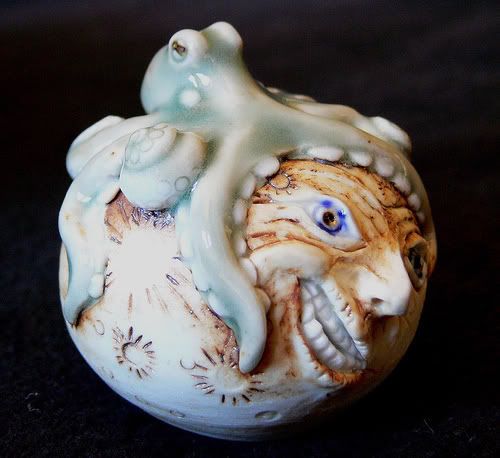
Vía locamotion
A mí esta escultura me recuerda mucho a la imagen de George Meliès de la luna con el cohete en el ojo (El viaje a la Luna), pero en vez de estar malhumorada, ésta en cambio parece divertirse de tener un pulpo correteando por su superficie. De todas maneras no sé si tiene algún significado especial. Seguiré investigando.
Vía locamotion
A mí esta escultura me recuerda mucho a la imagen de George Meliès de la luna con el cohete en el ojo (El viaje a la Luna), pero en vez de estar malhumorada, ésta en cambio parece divertirse de tener un pulpo correteando por su superficie. De todas maneras no sé si tiene algún significado especial. Seguiré investigando.
Okimono
Vía galería Kitsunegaroo
When talking about miniature sculptures, the first object that comes to our mind is the netsuke. Okimono, the larger ornamental carvings, are much less popular. They were made as ornaments for the tokonoma. Like netsuke, they represent Japanese habits and mythology. Buddhist idols and Noh masks inspired many artists when creating these miniature sculptures. They were made out of wood and ivory and very often sculptured by netsuke carvers during the Meiji period. Wood was the only material employed during different centuries both in temples and Japanese housing. Around the 18th century the use of ivory increased. At the beginning of this century, the samisen (a stringed instrument) music became very popular. The plectrum to play this instrument was made out of the centre part of the tusk of an elephant. The small pieces that were left over were ideal for the carving of netsuke and, at a later stage, okimono. The Westernisation brought far-reaching changes to Japan. Artists had to adapt their concepts to the demand of the Western world. As a result of the influence from the West, pockets were now added to the Japanese kimono, eliminating the need for netsuke. During the Meiji period netsuke were still produced for collectors, but more and more netsuke carvers began to focus on okimono. Because of the great demand for okimono for export, many artists started to produce objects of an inferior quality. However, there were also carvers that created beautifully sculptured okimono and followed the traditional high standard of their craft. The classification of wood and ivory okimono can be done by school (such as Kyoto or Tokyo schools), but the merit of each object leads to two trends in okimono carving that make the classification more adequate. The first one sticks to the Japanese tradition and can be recognized by strong modelling with striking poses, flowing lines and strongly expressed emotions. Traces of round and flat chisel marks can be found on some of these okimono. For the Japanese art lovers these chisel marks have the same appeal as the brush strokes in painting. The demand from the West leads to the second trend where good craftsmanship was characterised by a smooth surface without chisel marks.
Arte y pulpos- Octopus netsuke-
Published Monday, July 25, 2005 by Spyder.
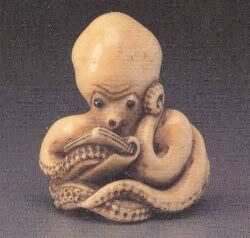
Talla de marfil japonesa que representa un pulpo leyendo mientras con uno de sus tentáculos sostiene su cabeza.
Existe una leyenda japonesa que explica que Ryuijin que es el dios dragón del mar según la mitología japonesa, vivía en un palacio submarino. Ryuijin que tenía un cuerpo de serpiente, tenía a su cargo a las criaturas marinas y entre éstas estaba un pulpo que le hacía de médico.
Es por eso por los que muchos doctores usan el netsuke de un pulpo para los bolsillos de sus kimonos.
Netsuke
Tiny sculptures used to secure pouches to the kimono – have long been an obsession for collectors in both East and West. They depict a variety of figures, both domestic and exotic, from marketplace tradesmen to otherworldly beings to perfectly rendered animals.
Octopus Netsuke en el Museum of Fine Arts de Boston
Erotismo con pulpos -Posturas del amor-
Published Thursday, June 30, 2005 by Spyder.

Mira que a mí estas cosas me salen innatas...
El pulpo
Tumbada sobre la espalda, la mujer toma una posición inclinada apoyando su cintura y sus nalgas sobre las rodillas y los muslos de su pareja. El hombre la levanta por la cadera para cambiar el ángulo y la profundidad de la penetración. El hombre puede liberar una mano para acariciar los senos y el busto de su pareja.
Ahora bien, si quieres aprender como se hace el bambú, la boa, el elefante o la cortesana, puedes consultar la web de Mujer Actual. Las imágenes desde luego son aclaratorias, e incluso mucho mejor que el propio Kamasutra, que si tienen la oportunidad de leerlo les prevengo que no entenderán ni la mitad...
Labels: Erotismo
Erotismo con pulpos -Octopus porn-
Published Wednesday, March 09, 2005 by Spyder.

Sin duda uno de los links más subidos de tono que hemos colocado en este blog. Directo a satisfacer las fantasías de los octófilos: octopus porn.
Labels: Erotismo
Erotismo con pulpos -Juguete Hentai-
Published Sunday, February 27, 2005 by Spyder.
Erotismo con pulpos -Tentacle Porn-
Published Saturday, February 26, 2005 by Spyder.
Sin duda uno de los artículos más completos sobre la pornografía tentacular. Ahí todos los octófilos encontrarán las respuestas.
Via blog de The Emperor
Tentacle Porn
I often use tentacle porn as an example of the strangeness of the Internet (in that it caters for just about every strange desire someone may ever have) but what is it? It essentially invovles the usually non-consensual penetration. The main site for this kind fo thing is Shokushu High School, which contains an awful lot of high quality anime/manga drawings of very distrubing sex acts (as well as some really poor quality photomanpilualtions) and The Xenophile, which has more amateurish drawings (which for me is more unsettling). There are also connections with vore (which is getting your kicks from being eaten) sites like Chupacabras Dark Domain. All pretty unsavoury and the kind of thing that psychopaths might get off on but that doesn't explain its widespread popularity (and trust me - it is big, even 'mainstream', in Japan). Where it has really gone overground is in a number of manga films most famously with the Urotsuki Doji Saga which includes the infamous "Legend of the Overfiend" described here as:
quote:
... the the most famous tentacle rape and super-violent horror in the history of anime.
Other examples include "La Blue Girl" which started off animated and span off a live action version. Fully live action is the series of films (there seem to be 5) called Injukyoshi which impresively translates to "Obscene Beast Teacher". And if there needed to be any other sign of how widespread it is there is even gay tentacle porn The main reason for this is that hentai (anime porn) by convention doesn't show penises (technically the Japanese censorship laws don't allow the depiction of male or female genitals or pubic hair) and so inventive anime authors and artists have used the tentacle as a replacement - see this everything2 entry for further explanation. An interview with Toshio Maeda, the creator of the and describe elsewhere in the piece as "the master of tentacle violation", gives his overview of how it came about :
quote:
CJ: Can you talk about how the tentacle came to be used in your work? TM: At that time [pre-Urotsuki Doji], it was illegal to create a sensual scene in bed. I thought I should do something to avoid drawing such a normal sensual scene. So I just created a creature. [His tentacle] is not a [penis] as a pretext. I could say, as an excuse, this is not a [penis], this is just a part of the creature. You know, the creatures, they don't have a gender. A creature is a creature. So it is not obscene - not illegal. Drawing intercourse was, and is, illegal in Japan. That is our big headache: to create such a sensual scene. We are always using any type of trick.
Which explains it but it doesn't make it right. In fact in a recent development Motonori Kishi was charged with obscenity for producing manga which failed to conceal the genitals:
quote:
"Bodies were drawn in a lifelike manner with little attention to concealment (of genitalia), making for sexually explicit expression and deeming the book pornographic matter," Mr Nakatani said.
Tentacle porn also crops up in a more light-heartd way with various Cthulhu sites looking into this area (although Cthulhu Sex.com doesn't):
· Cthulhu Myth Hoes
· alt.sex.cthulhu archive It also crops up in The Lighter Side of Tentacle Hentai and is a recurring theme at Ghastly's Ghastly Comic which has the strapline: 'Tentacle Monsters and the Women Who Love Them' (they also sell a range of merchandise through Cafepress but who'd want to wear something like that? Well not until they make it available on a black T shirt anyway). It has even made an appearance in a Weebl and Bob cartoon!! And don't think this hasn't intruded into the mainstream!! There is currently furore over the display of the Victorian painting 'The Dream of the Fisherman's Wife' by David Laity as detailed by NEWS.com.au which is a redrawing of Hokusai's original woodcut (reproduced below - translation of the text): This reworking continues to the modern day - as part of his 'Waves and Plagues' collection Masami Teraoka has also brought this up to date with his 2002 work "Sarah and Octopus/Seventh Heaven" which uses traditional art forms like ukiyo-e to address modern themes (his work has been covered in the documentray The Floating World). It may have also influenced Toshio Saeki's "Octo-girl". I also stumbled across a modern silk screen print inspired by it. Worryingly it has been inspired Hokusai manga aka Edo porn a 1981 film giving an erotic version of Hokusia's life with an eye opening reconstruction of the famous painting. While that is bordering on the laughable there are more disturbing examples of women and octopus "sex" (and yes you should think twice before clicking that link) although its unclear if the inspiration was directly from Hokusia (or even how alive the octopus is leading to accusations of necroctoporn). Rather than being some kind of backroom kinkiness tentacle porn is widely available in Japan and although the above is shunga (shunga were the illustrations to erotic books, etc.) Katsushika Hokusai (1760-1849) is better know for his landscapes (and his woodcuts are very well known) and he apparently coined the term manga (which means "whimsical sketches"). Its probably western European puritanism which insists on the erotic (and esp. the strangely erotic) being dirty and confined to some backroom - you can find the above picture reporduced as netsuke (a miniature sculpture originally a toggle for one's purse or to stop items from slipping off your kimono cord), prints and stained glass. However these appear to be modern interpretations of the theme but there are apparently versions from the 1760-1770s and good overviews of these older pieces can be found here and here. And before people roll their eyes and say "only in Japan" they should read this article on the erotic potential of the octopus. And this piece entitled "Kracken Power! Getting Jiggity with Cephalopods" which is one woman's description of why she enjoys this kind of thing. Also the topic of (often non-consensual) bestiality isn't confined to Japan and one of the most famous versions of this theme is the legend of "Leda and the Swan" where Zeus took on the form of the swan to have his evil way with Leda. It has inspired some of the greatest artists resulting in a poem by W.B. Yeats as well as countless paintings by the likes of Cezanne, Correggio, da Vinci and Matisse (and numerous other artists). It is also a background theme in Peter Greenaway's 1985 film A Zed and Two Noughts (which is a very very strange film in itself). So drawing the various threads together I'd suggest that the reason for tentacle porn and why we in the West view it as very strange is because of the difference between animism, religions still based on the worship of nature (like Shinto), and Christianity (which rejected a lot of 'pagan' practices but incorporated others). As can be seen above pre-Christian European myths dealt openly with the blurring of the line between human and animal (even into sexual areas). Shinto, which worships numerous gods which are aspects of nature, is widespread in Japan and was once the state religion - it also has no strict rules, etc. and people can incorporate aspects of Shinto into other religions so the general ideas are even more widespread in Japan. It has to be relevant that the Edo Period (1600-1868), from which all the original pieces date from, saw an upsurge in the worship of Shinto. (information on Shinto). Although the modern resurgence in tentacle porn is a way to work around the rules of hentai it appears, to me anyway, that Japanese culture was more open to this kind of imagery.
Also the issue of cephalod reproduction comes up a lot in the world of science - in fact a posting at the Fortean Times forum pointing to this kind of thing was called Squid porn attempt which discussed BCC report on an attmept to trap squid using sex as the bait. A recent report in Nature also touched on the erections of octupi (no pun intended). See: Norman, M.D. & Lu, C.C. (1997) Sex in giant squid. Nature 389. 683 - 4. File this under 'Its a funny old world' and then try and forget all about it ;)
Links: Anime Encyclopedia's tentacle porn entry - it is allegedly also known as 'naughty tentacles'. Wikipedia entry - which I have contributed to.
Labels: Erotismo
Erotismo con pulpos -Niklas Jansson- Flying Spaghetti Monster-
Published Monday, February 07, 2005 by Spyder.
Una nueva versión del cuadro de Hokusai muy divertida hecha por el artista Niklas Jansson que pinta al famoso Flying Spaghetti Monster.

El Monstruo del Spaguetti Volante viene por una disputa que se creó cuando la administración Bush implantó el creacionismo en algunas escuelas en contra de la teoría admitida por la comunidad científica del evolucionismo. Un físico llamado Bobby Henderson en tono irónico y como manera de protesta se declaró profeta de un nuevo Dios Spaguetti y fundó la iglesia del pastafarismo. Ese Dios Spaguetti tuvo eco en la obra de muchos artistas, así que de Flying Spaghetti Monster tuvo sus apariciones en distintas ciudades.
I am writing you with much concern after having read of your hearing todecide whether the alternative theory of Intelligent Design should be taughtalong with the theory of Evolution. I think we can all agree that it isimportant for students to hear multiple viewpoints so they can choose forthemselves the theory that makes the most sense to them. I am concerned,however, that students will only hear one theory of Intelligent Design.Let us remember that there are multiple theories of Intelligent Design. Iand many others around the world are of the strong belief that the universe wascreated by a Flying Spaghetti Monster.
El Monstruo del Spaguetti Volante viene por una disputa que se creó cuando la administración Bush implantó el creacionismo en algunas escuelas en contra de la teoría admitida por la comunidad científica del evolucionismo. Un físico llamado Bobby Henderson en tono irónico y como manera de protesta se declaró profeta de un nuevo Dios Spaguetti y fundó la iglesia del pastafarismo. Ese Dios Spaguetti tuvo eco en la obra de muchos artistas, así que de Flying Spaghetti Monster tuvo sus apariciones en distintas ciudades.
I am writing you with much concern after having read of your hearing todecide whether the alternative theory of Intelligent Design should be taughtalong with the theory of Evolution. I think we can all agree that it isimportant for students to hear multiple viewpoints so they can choose forthemselves the theory that makes the most sense to them. I am concerned,however, that students will only hear one theory of Intelligent Design.Let us remember that there are multiple theories of Intelligent Design. Iand many others around the world are of the strong belief that the universe wascreated by a Flying Spaghetti Monster.
Labels: Erotismo
Erotismo con pulpos -David Laity-
Published Sunday, February 06, 2005 by Spyder.
La versión que hizo el artista australiano David Laity del cuadro de Hokusai El sueño de la esposa del pescador que tituló Bailando con Katsushika Hokusai.


Via Metro 5 Gallery
"Dream of the Fisherman's Wife is adapted from an early Japanese woodcut titled Dancing With Katsushika Hokusai. The original woodcut, smaller than A4 was printed over 200 years ago.
Dream of the Fisherman's Wife departs from the flirty, sensual imagery evident in David's other paintings, and moves into confronting erotic mythology."I have been aware of this image for years and loved it. I always thought that life-size it would be so powerful. In the mode of Pop Art I wanted to re-make this image in my style.
"I love that this image brings the historic tradition of sexually explicit art into contemporary Australian life, bridging a tradition of erotic painting across centuries and cultures.
"It's a wonderful wild image."
"I love that this image brings the historic tradition of sexually explicit art into contemporary Australian life, bridging a tradition of erotic painting across centuries and cultures.
"It's a wonderful wild image."
Labels: Erotismo
Erotismo con pulpos -Katsushika Hokusai- El sueño de la esposa del pescador
Published Saturday, February 05, 2005 by Spyder.
Katsushika Hokusai, nació en Tokio, Japón, en 1760, en el período conocido como la época de Edo, y produjo bellísimos grabados y pinturas, en los que retrata la naturaleza en todo su esplendor.
Son famosas sus obras sobre el Monte Fuji, así como los grabados con temas marinos, en los que figuran frágiles barcos azotados por gigantescas olas, que parecen cobrar vida ante los ojos de los espectadores.
Son famosas sus obras sobre el Monte Fuji, así como los grabados con temas marinos, en los que figuran frágiles barcos azotados por gigantescas olas, que parecen cobrar vida ante los ojos de los espectadores.
Hokusai cuando pinta El sueño de la esposa del pescador se convierte en un referente dentro del erotismo pulpero. El grabado representa a una mujer manteniendo sexo con dos pulpos y es uno de los ukiyo-e (pinturas del mundo flotante) más reconocidos. David Laity rehizo el ukiyo-e de El sueño de la esposa del pescador en una pintura con el mismo nombre, y Masami Teraoka actualizó la imagen con su trabajo en el 2001 "Sarah and Octopus/Séptimo Cielo", parte de su colección Olas y Plagas.

The Dream of the Fisherman's Wife is an erotic woodcut made circa 1820 by Hokusai, perhaps the first instance of tentacle porn. It features a woman entwined sexually with a pair of octopuses. She is kissing a small octopus, while a larger one is performing cunnilingus on her. This ukiyo-e woodcut arose in the Edo period in Japan when Shinto was making a resurgence and the resulting Animism and a more playful attitude to sexuality combined powerfully in Hokusai's piece. It is a celebrated example of shunga and has been reworked by a number of artists including:
David Laity reworked the woodcut into a painting of the same name. He claims that the original piece was actually titled "Dancing With Katsushika Hokusai".
Masami Teraoka brought the image up to date with his 2001 work "Sarah and Octopus/Seventh Heaven part of his "Waves and Plagues" collection.
A parody image featuring the Flying Spaghetti Monster has been created by artist Niklas Jansson.
British artist Lali Chetwynd included a reenactment of the woodcut as part of her performance of "Erotics and Beastiality: Depraved Creativity" at the Liverpool Biennial of 2004. The scene saw bikini clad artist Eva Stenram disappear legs first into the costume of the slowly gyrating animal, operated by writer Tom McCarthy.
David Laity reworked the woodcut into a painting of the same name. He claims that the original piece was actually titled "Dancing With Katsushika Hokusai".
Masami Teraoka brought the image up to date with his 2001 work "Sarah and Octopus/Seventh Heaven part of his "Waves and Plagues" collection.
A parody image featuring the Flying Spaghetti Monster has been created by artist Niklas Jansson.
British artist Lali Chetwynd included a reenactment of the woodcut as part of her performance of "Erotics and Beastiality: Depraved Creativity" at the Liverpool Biennial of 2004. The scene saw bikini clad artist Eva Stenram disappear legs first into the costume of the slowly gyrating animal, operated by writer Tom McCarthy.
The anime series Samurai Champloo made playful reference to this image in episode 5, "Artistic Anarchy". Mugen, looking through a ukiyo-e artist's collection, comments "Whoa, doin' it with a squid". The series is set in roughly 1675, well before the creation of this image, but anachronism is one of the hallmarks of Champloo.
The collection of the comic book Commies from Mars: The Red Planet has a parody image as part of the general mayhem of Martians taking over the Earth. Artwork by John Pound.
Similar themes of human females having sexual intercourse with sea life have been displayed since the 17th century in Japanese netsuke, small carved sculptures only a few inches in height and often extremely elaborate. Once, people walked the streets of Edo with their moneypurses hanging from their belts, netsuke-pulls of human-marine erotica dangling from their drawstrings.
The collection of the comic book Commies from Mars: The Red Planet has a parody image as part of the general mayhem of Martians taking over the Earth. Artwork by John Pound.
Similar themes of human females having sexual intercourse with sea life have been displayed since the 17th century in Japanese netsuke, small carved sculptures only a few inches in height and often extremely elaborate. Once, people walked the streets of Edo with their moneypurses hanging from their belts, netsuke-pulls of human-marine erotica dangling from their drawstrings.
Labels: Erotismo
Erotismo con pulpos
Published Tuesday, February 01, 2005 by Spyder.
Vía El mundo.es
A propósito de un grabado japonés del siglo pasado, el autor de este artículo especula sobre la sexualidad femenina a través una serie de obras de arte que guardan un punto en común
El erotismo del pulpo
ALBERTO HERNANDO
Hacia 1820 el maestro japonés Hokusai realizó un grabado que mostraba a un pulpo cuya boca está adherida al sexo de una mujer mientras sus tentáculos se introducen por su boca, sujetan uno de sus pezones y se enroscan por sus piernas y nalgas. El dibujo tiene por título El sueño de la mujer del pescador. En la escena confluyen una serie de íntimas fantasías eróticas de la mujer: la viscosidad animal, lo tentacular, lo húmedo, el horror monstruoso, el goce convulsivo y la violencia lúbrica.
El grabado de Hokusai, cuando fue conocido en los círculos artísticos occidentales, especialmente por los decadentistas, causó una gran conmoción y fue celebrado como la expresión magistral de la animalidad del deseo donde se rehabilitaba la lujuria vinculada al sufrimiento. Joris-Karl Huysmans, dirá al respecto: «¡La expresión casi sobrehumana de angustia y de dolor que convulsiona a esa larga figura de Pierrot, de nariz arqueada, y la alegría histérica que filtra al mismo tiempo de esa frente, de esos ojos cerrados de muerte, son admirables!». Otro decadentista, Felicien Rops, maestro del erotismo sacrílego y maldito, reproduciría la imagen de una manera mucho más compulsiva: una mujer desnuda se debate frente a un pulpo sujetando con cada una de sus manos fálicos tentáculos mientras que otros la penetran por la boca y la vagina y al mismo tiempo la hiere con su punzante pico.
La atracción por el tema desde la perspectiva pictórica ha perseverado hasta nuestros días: Masami Teraoka, en clave pop art y parodiando la escena de Hokusai, dibuja una mujer rubia californiana pugnando contra un pulpo cuyos tentáculos están preservados por condones (New Wave Series: Eight-Condom Fantasy): a la clave de horror erótico que conlleva la imagen del pulpo se adiciona la referencia a la amenaza de contagio letal. En relación con los condones, un aditamento de imaginación erótica y ampliación del placer son los french ticklers (cosquillas francesas) o preservativos cuya punta está provista de apéndices simulando los tentáculos de un pulpo. En esta ocasión, la forma simbólica del pulpo se reduce estratégicamente para que la posesión del cuerpo femenino sea intestina, penetre en los más hondo, frote y excite cada rincón de la vagina.
Hasta la aparición del grabado de Hokusai, la figura del pulpo velaba un discurso de lo reprimido. Simbólicamente el pulpo era asimilado al terror de los monstruos marinos (las leyendas escandinavas sobre los Kraken), señal de peligro de que algo o alguien intenta hundirte (adivinación por los posos del té); emblema de tiranía o gula extrema (Horapolo en su Hieraglyphica); o representación de un ser maligno y dañino que contrasta con el amor puro, como se evidencia en la obra de Rafael titulada Galatea, donde se expone, como exaltación del triunfo del Amor sobre el Mal, a un delfín -imagen del amor que se entrega hasta la muerte- devorando a un pulpo. Sólo Eliano, escritor griego del siglo III, en su Historia Natural habla de la incontinencia sexual del pulpo que le debilita de tal forma que constituye presa fácil para los cangrejos.
En psicología, la figura del pulpo que aparece en sueños se interpreta como complejos neuróticos que remiten a personas a las que se teme o que ejercen un dominio absorbente y tiránico; especialmente la madre castradora. En otras ocasiones, acorde con la tradición misógina freudiana, se identifica al pulpo con el miedo al sexo femenino. Por esa potencia onírica o fijación inconsciente, la imagen del pulpo en sus connotaciones eróticas ha sido un lugar común de los surrealistas. Isidore Ducasse, más conocido por Lautréamont y surrealista avant la lettre, convierte al protagonista de sus Cantos de Maldoror en un pulpo para atrapar a Dios mediante sus «Cuatrocientas ventosas bajo las axilas, hasta hacerle lanzar terribles gritos» que se convertían en «víboras» y «reptantes dotados de innumerables anillos» que «han jurado dar caza a la inocencia humana».
Dalí realizará en 1963 un dibujo dedicado a su amigo Carles Alemany titulado San Jorge luchando contra el pulpo: San Jorge se enfrenta a un pulpo enarbolando un escudo ornamentado con una cabeza de medusa. Un ojo monstruoso de largas pestañas se halla en el centro de la cabeza del pulpo; sus tentáculos están complementados por varios penes, de los cuales uno eyacula sobre el sexo de una mujer abierta de piernas. Hans Bellmer titula uno de sus grabados Cefalópodo (1968): una joven tendida muestra su sexo desde la perspectiva del culo que sirve a un tiempo para perfilar una cabeza cuya oreja se sobrepone a los repliegues de la vulva.
La poesía surrealista igualmente se hizo eco de la sugerente eroticidad del pulpo. Joyce Mansour en su obra Déchirures (1954) escribirá: «Llegan la noche y tu éxtasis/Y mi cuerpo profundo ese pulpo sin pensamiento/Engulle tu sexo agitado/Durante su nacimiento». En el poema titulado El cazador de cabezas de Michel Leiris, contenido en Haut-mal (1943), podemos leer: «La noche me abre la docilidad de sus arcanos/pero a sus pentaclos chisporreantes prefiero/el pentagrama de tu cuerpo/Cinco sentidos Cinco Tentáculos El Pulpo/hincha de sangre sus brazos pero cuánto más prefiero/la alhaja pesada de tus entrañas en la que nunca penetra la luz/a no ser el mástil deslumbrador/en el minuto en que la fauna misteriosa de un país ignorado/acude a beber en nuestra fuente/Cinco tentáculos Cinco hojas de acero».
Como fantasía tenebrosa de la mujer, Andrzej Zulawski en su filme Posesión, interpretado por Patricia Adjani, cuenta la inquietante historia de una mujer cuyo deseo crea un monstruo tentacular que la posee y destruye a todo competidor humano que se la acerque. Esa metáfora del deseo extremo ilustra la potencia de la mujer para crear sus propias realidades a partir de la fantasía.
Llegados a este punto a través de las derivaciones simbólicas del pulpo, cabe preguntarse, ¿el pulpo es una fantasía erótica específica de la mujer, o una proyección de los miedos del hombre? Ciertamente, parece lógico que es compatible con la mujer la posibilidad de fantasear sobre un ser que a un tiempo pulse y penetre todas las partes erógenas, despierte los sentidos, intensifique el placer y armonice los ritmos precisos, independientes, sincronizados, de las zonas de la carne sensibles al gozo; que dirija todas las sensaciones a una apoteosis múltiple, a un orgasmo multiplicado, a un frenesí exuberante y delirante. La mujer en ese abandono lograría a un tiempo ser objeto y usuaria de placer. Procopio en su Anécdota cuenta como la emperatriz Teodora trató de experimentar ese climax en un lance amoroso al «satisfacer completo y simultáneamente todos los orificios amorosos del cuerpo humano».
Por otro lado, el hombre, en su voracidad sexual, ha parcelado a la mujer como si fuera un territorio jalonado de agujeros a sobreponer, dominar, enchufar, insertar, acoplar... El poder sedicente del sexo masculino cree fundamentarse en esa lógica militar de ocupación. Esa obsesión por cubrir todos los orificios femeninos se manifiesta plásticamente en innúmeros dibujos que ilustran las obras libertinas del siglo XVIII donde la combinatoria de los cuerpos en la orgía muestra las diversas maneras de lograr una maximización sexual entre los componentes del grupo. Sin embargo, esa pretensión de dominio total del cuerpo femenino, esa ilusoria creencia de satisfacerla plenamente, queda desmentida por la realidad fisiológica: el breve tiempo de duración de la erección masculina denuncia su debilidad sexual y desmiente esa absurda pretensión de omnímoda potencia de satisfacción del gozo femenino. Fantasía que vela, sin duda, ese conocimiento de precariedad o descompensación respecto a la potencia orgásmica de la mujer. Miedo que asimismo, explicaría la posible y vergonzante proyección de la figura del pulpo como deseo de la mujer. Como sea, el pulpo será una sugerente metáfora más en las fronterizas relaciones entre hombres y mujeres.
Labels: Erotismo


