Pulpos -Curiosidades- El extraño fenómeno del Bloop-
Published Wednesday, January 03, 2007 by Spyder.
Durante la guerra fría Estados Unidos colocó micrófonos marinos con el fin de detectar submarinos soviéticos. En 1997 en la zona del Pacífico Sur estos micrófonos detectaron durante varios minutos un sonido muy fuerte de origen desconocido al que los científicos llamaron Bloop.
Algunas de las teorías explican que el causante de ese sonido pudiera ser algún tipo de calamar o pulpo gigante de una especia hasta ahora desconocida.
Se puede leer más información en este foro de telecomunicaciones.
En inglés podemos encontrar la página de Bloopwatch dedicada al estudio del Bloop.
Algunas de las teorías explican que el causante de ese sonido pudiera ser algún tipo de calamar o pulpo gigante de una especia hasta ahora desconocida.
Se puede leer más información en este foro de telecomunicaciones.
En inglés podemos encontrar la página de Bloopwatch dedicada al estudio del Bloop.
Labels: Curiosidades, Monstruos marinos
Pulpos y montajes (III)
Published Wednesday, December 27, 2006 by Spyder.
Montajes con revival de películas, de la mano de Worth1000.
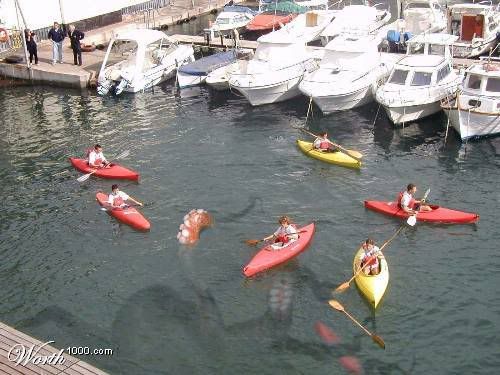
¿Quién no ha visto la película de Joe Dante “Piraña” donde una horda de pirañas se dirigen río abajo hacia un lugar de veraneo que acaba de ser inagurado... la misma agradable sorpresa que parece que se van a llevar estos piragüistas.
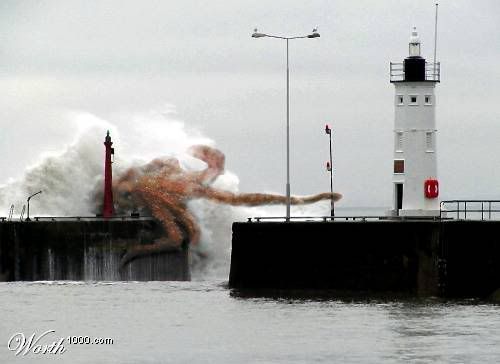
Esta imagen tiene reminiscencias del clásico “It came from beneath the sea” en su versión Godzilla
¿Quién no ha visto la película de Joe Dante “Piraña” donde una horda de pirañas se dirigen río abajo hacia un lugar de veraneo que acaba de ser inagurado... la misma agradable sorpresa que parece que se van a llevar estos piragüistas.
Esta imagen tiene reminiscencias del clásico “It came from beneath the sea” en su versión Godzilla
Labels: Monstruos marinos, Montajes
Pulpos y montajes (II)
Published Saturday, November 25, 2006 by Spyder.
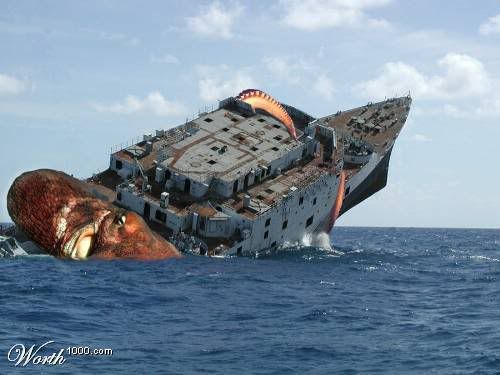
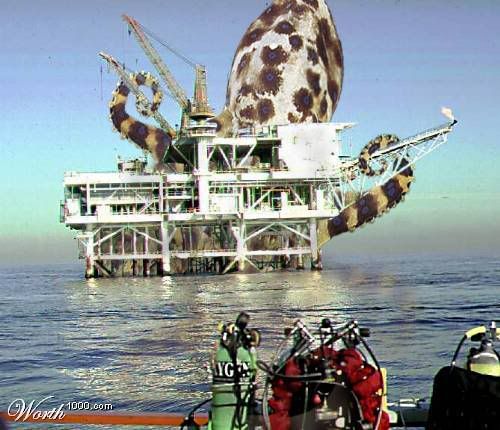
Más montajes, esta vez con las temidas criaturas del fondo del mar amenazando lo fabricado por el hombre. Las imágenes están sacadas de la web de Worth1000.
Labels: Monstruos marinos, Montajes
Calamar gigante -Disfraz-
Published Thursday, November 16, 2006 by Spyder.
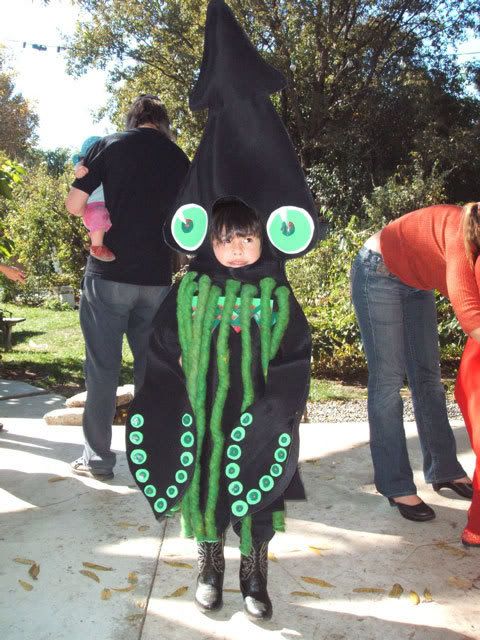
Rara especie de calamar gigante capaz de caminar sobre dos de sus tentáculos (botines para más datos). Corresponde a una de las pocas fotografías que se han podido tomar de un ejemplar vivo.
Labels: Humor, Monstruos marinos
Roger Caillois -El pulpo como araña gigante-
Published Thursday, August 03, 2006 by Spyder.
"El pulpo trae la realidad de un arácnido gigante y marino. Víctor Hugo hasta descubre un pulpo de agua dulce, una araña precisamente, en la argironeta, que está al acecho debajo la campana llena de aire que teje entre las plantas acuáticas. Ya se ha visto que, en el momento del combate que opone el pulpo a Gilliatt, Hugo escribe, para expresar el desamparo de su héroe, que era "la mosca de esta araña". Al mismo psicoanálisis, aunque cuando sea difícil, por no decir imposible, confundirlo, parece haberle costado discernir el sentido respectivo de ambos símbolos fraternos. El uno y la otra, a su juicio, representan la Madre-Terrible y la Fatalidad. Charles Baudouin lo explica a propósito de Hugo. J. Schnier, al interpretar las confidencias de una joven, cree poder afirmar que; por lo menos en ella, el pulpo simboliza la atracción y el amor que ella siente por su madre, mientras que la araña representa la repulsión que ésta le produce concurrentemente.
Ahora bien, aquí poco importan los resortes de este nuevo tipo de mitología, no obstante sean muy instructivas las concordancias que establece. El pulpo se presenta ante el ojo ingenuo como una araña gigantesca y viscosa, más temible tal vez por el hecho de vivir en otro medio y de estar no en el centro de una trampa, sino de ser en cierto modo trampa en sí. El es a la vez la tela que paraliza y el monstruo que devora."
Ahora bien, aquí poco importan los resortes de este nuevo tipo de mitología, no obstante sean muy instructivas las concordancias que establece. El pulpo se presenta ante el ojo ingenuo como una araña gigantesca y viscosa, más temible tal vez por el hecho de vivir en otro medio y de estar no en el centro de una trampa, sino de ser en cierto modo trampa en sí. El es a la vez la tela que paraliza y el monstruo que devora."
Roger Caillois -Mitología del pulpo-
Labels: Literatura, Monstruos marinos
Calamar gigante- El Taningia Danae-
Published Saturday, July 15, 2006 by Spyder.
Aparte de la familia del Architeuthis, la siguiente especie más conocida es la del Taningia. Es menos común que el Architeuthis (que ya cuesta encontrarlo), por lo que existe menos información sobre el Taningia. Y ocurre como el calamar gigante, que los pocos ejemplares que se encuntran aparecen en los estómagos de ballenas cachalote.
 Pero aunque no se prodigue demasiado es muy fácil reconocerlo por sus especiales características. Es un calamar más corto y ancho, con ocho brazos,(no posee los dos tentáculos largos como el architeutis ) que en lugar de ventosas tienen pequeñas garras o ganchos con las que captura a sus presas. Pero lo más curioso del Taningia son sus dos órganos luminosos que emiten luz amarilla y que son los mayores órganos luminosos del reino animal.
Estos fotóforos, situados en el extremo de su segundo par de brazos, son los miembros luminosos de mayor tamaño del reino animal y están equipados con una membrana oscura que pueden mover a voluntad ( como una especie de párpados que les permite producir efectos luminosos como efecto flash, centelleado u otros tipos de juegos de luces).
Un pequeño espécimen de Taningia (60 cm) fue capturado vivo y sin daños en Hawai, e introducido en un barco-acuario, donde fue observado y fotografiado. Era la primera vez que se observaban los “fotóforos”. En plena oscuridad se le estimuló mediante la luz de una linterna, y el Taningia respondió iluminando sus fotóforos en distintas secuencias. Lo más seguro es que el Taningia utilice las luces para relacionarse con los de su especie, y es posible que también utilice sus luces para atraer a algunas de sus presas.
El primer Taningia danae fue cogido en las Islas de Cabo Verde por un barco de origen danés. El nombre genérico de Taningia se debe a Aage Vedel Taning (1.890-1.958), un importante biólogo marino danés y el primero en ponerle nombre a esta especie, aunque en el mundo marinero también se les puede llamar con el nombre de pulpo-pota.
Para leer más.
- CEPESMA
- The Cephalopod Page
 Pero aunque no se prodigue demasiado es muy fácil reconocerlo por sus especiales características. Es un calamar más corto y ancho, con ocho brazos,(no posee los dos tentáculos largos como el architeutis ) que en lugar de ventosas tienen pequeñas garras o ganchos con las que captura a sus presas. Pero lo más curioso del Taningia son sus dos órganos luminosos que emiten luz amarilla y que son los mayores órganos luminosos del reino animal.
 Estos fotóforos, situados en el extremo de su segundo par de brazos, son los miembros luminosos de mayor tamaño del reino animal y están equipados con una membrana oscura que pueden mover a voluntad ( como una especie de párpados que les permite producir efectos luminosos como efecto flash, centelleado u otros tipos de juegos de luces).
Un pequeño espécimen de Taningia (60 cm) fue capturado vivo y sin daños en Hawai, e introducido en un barco-acuario, donde fue observado y fotografiado. Era la primera vez que se observaban los “fotóforos”. En plena oscuridad se le estimuló mediante la luz de una linterna, y el Taningia respondió iluminando sus fotóforos en distintas secuencias. Lo más seguro es que el Taningia utilice las luces para relacionarse con los de su especie, y es posible que también utilice sus luces para atraer a algunas de sus presas.
El primer Taningia danae fue cogido en las Islas de Cabo Verde por un barco de origen danés. El nombre genérico de Taningia se debe a Aage Vedel Taning (1.890-1.958), un importante biólogo marino danés y el primero en ponerle nombre a esta especie, aunque en el mundo marinero también se les puede llamar con el nombre de pulpo-pota.
Para leer más.
- CEPESMA
- The Cephalopod Page
Labels: Monstruos marinos
Calamar gigante -El proyecto Kraken-
Published Friday, July 14, 2006 by Spyder.
El proyecto Kraken fue el intento en septiembre de 2002 por parte de un equipo de científicos y técnicos españoles de filmar en la zona del caladero de Carrandi al calamar gigante; auspiciados por el CSIC Y la productora Transglobe Films se intentó rodar imágenes de algún ejemplar de Architeuthis dux o la Tanigia deana, ambas especies viven en el Atlántico norte entre los 200 y los 1200 metros de profundidad.
Las especies objetivos eran el Architeuthis dux y la Tanigia deana, ambas viven en el Atlántico norte entre 200 y 1200 metros de profundidad. La expedición duró 15 días filmando durante las 24 horas del día. Participaron en el proyecto 18 científicos y realizadores del documental y unos 8 tripulantes.

Para intentar tomar imágenes de estas criaturas, se delimitó un triángulo equilátero de 500 metros cuadrados con cámaras en sus vértices, estas filmando durante todo el día. En el centro del triángulo se vertieron hasta una tonelada de cebo orgánico (caballa, jurel fresco, harina de pescado, etc), también se usaron cebos electrónicos, queriendo imitar los impulsos de animales marinos (emisoras sonoras de baja frecuencia) y cebos luminosos y sonoros (potentes focos). El equipo también contó con dos cámaras robots que grababan hasta a 300 metros de profundidad y una cámara móvil capaz de bajar hasta a 800 metros.
Después de esos quince días, aunque se consiguieron visualizar innumerables clases de peces abisales, tiburones ciejos, y demás criaturas de fondos abismos, no se consiguieron las imágenes que se estaban buscando.
Fue finalmente una expedición japonesa la que consiguió las primeras imágenes del calamar gigante, como narrábamos aquí.
Para leer más sobre el proyecto Kraken:
- Artículo de Jesús M. Salamanca sacado del Periodista Digital.
- En esta página dedicada al Kraken y a otros monstruos marinos.
Las especies objetivos eran el Architeuthis dux y la Tanigia deana, ambas viven en el Atlántico norte entre 200 y 1200 metros de profundidad. La expedición duró 15 días filmando durante las 24 horas del día. Participaron en el proyecto 18 científicos y realizadores del documental y unos 8 tripulantes.

Para intentar tomar imágenes de estas criaturas, se delimitó un triángulo equilátero de 500 metros cuadrados con cámaras en sus vértices, estas filmando durante todo el día. En el centro del triángulo se vertieron hasta una tonelada de cebo orgánico (caballa, jurel fresco, harina de pescado, etc), también se usaron cebos electrónicos, queriendo imitar los impulsos de animales marinos (emisoras sonoras de baja frecuencia) y cebos luminosos y sonoros (potentes focos). El equipo también contó con dos cámaras robots que grababan hasta a 300 metros de profundidad y una cámara móvil capaz de bajar hasta a 800 metros.
Después de esos quince días, aunque se consiguieron visualizar innumerables clases de peces abisales, tiburones ciejos, y demás criaturas de fondos abismos, no se consiguieron las imágenes que se estaban buscando.
Fue finalmente una expedición japonesa la que consiguió las primeras imágenes del calamar gigante, como narrábamos aquí.
Para leer más sobre el proyecto Kraken:
- Artículo de Jesús M. Salamanca sacado del Periodista Digital.
- En esta página dedicada al Kraken y a otros monstruos marinos.
Labels: Monstruos marinos, Noticias
Los depredadores del calamar gigante
Published Thursday, June 29, 2006 by Spyder.
Los únicos depredadores conocidos del calamar gigante cuando es adulto es el Cachalote, manteniendo estos unas batallas feroces con los calamares en las que los calamares normalmente llevan las de perder.
Se sabe que los Cachalotes son grandes depredadores de los calamares gigantes, por que se han encontrado muchos restos de calamares gigantes en los estómagos de cachalotes muertos, sobre todo picos de calamar ya que es lo mas difícil de digerir.
El intento de huida del Architeuthis hacia las profundidades donde habita, entre los 500 y 1500 metros de profundidad, no le sirve de nada, ya que el cachalote gracias a un aceite llamado Espermaceti, que se localiza en su cabeza, puede descender a esa profundidad tras el. Por tanto la supervivencia de este animal frente a tan descomunal depredador se basa en su pericia de despiste y su velocidad. Aunque no se tiene muy claro como los cachalotes atrapan a los calamares gigantes, pues estos pueden huir rápidamente al notar la presencia de su depredador; se cree que los cachalotes utilizan una especie de eco localización o sonar para detectar en la oscuridad de las profundidades marinas a los calamares gigantes, y que con este sistema los aturden y pueden llegar a capturarlos, ya que la enorme boca del cachalote esta mucho mas adaptada para atrapar presas que para desgarrarlas.
Labels: Monstruos marinos
Calamar gigante -Interview: Dr George Jackon-
Published Tuesday, June 27, 2006 by Spyder.
Y aquí la transcripción exacta del programa de radio australiano The World Today de la cadena ABC, en la que queda un poco más claro el porque de ese crecimiento de la población de calamares gigantes.
The World Today Archive - Thursday, 1 August , 2002 00:00:00
Reporter: Nicky Johnston
Reporter: Nicky Johnston
JOHN HIGHFIELD: Australians scientists are today offering proof that global warming needs to be taken much more seriously by the Howard government and its friends in Washington. You may recall the pictures of the giant squid found on a Tasmanian beach the other day.That's relevant, because our scientists say the same rising sea temperatures which are causing changing weather patterns and have brought devastating drought to large areas of Australia are also turning the world's squid into much larger creatures, with huge appetites and fast breeding cycles.The scientists say that they've found a 1 per cent increase in water temperature causes juvenile squid to double in size. In some parts of the world squid have already denuded vegetation and taken over ocean environments.As Nicole Johnston in Hobart reports for us, the biomass of all the world's squid is now heavier than that of us humans.
NICOLE JOHNSTON: Global warming and over fishing are environmental disasters that squid love. Their growth rates are tied to sea temperatures, in hot water squid eat more. They don't get fat because they have a protein-based system, and so they just grow large quickly. Recently a giant squid was found in Tasmania, and Dr George Jackson from the Institute of Antarctic and Southern Ocean Studies says expect to see more overgrown squid.
GEORGE JACKSON: The body alone was not far under two metres in length and it took about four people to actually turn it over when we wanted to look at the underside. And then it had a large head with large arms, probably as big as a man's upper arm. They've got eight of those and they've got two large tentacles that stretch out many metres.
NICOLE JOHNSTON: Scientists have discovered the breeding cycle and growth rate of squid is also linked to sea temperatures, which means global warming is causing the squid population to blow out.
GEORGE JACKSON: What's been found out, both with field work and in keeping squids in captivity, is that if you increase their temperature even just a little bit, it can have dramatic changes on how fast they grow and how quickly the mature. If global warming increases the world's oceans in particular areas, we could see an acceleration in squid growth, if there's plenty of food around, and that's the other issue we need.
NICOLE JOHNSTON: Dr George Jackson says squid are moving into regions where heavy over-fishing has left them with no natural competitors.
GEORGE JACKSON: If places have been overfished or the squid have been removed, squids have often moved into those areas and established themselves very quickly. Worldwide there's probably, if you look at the biomass of squid, there'd be more squid that the biomass of humans on the face of the earth.
NICOLE JOHNSTON: Dr Jackson says declining stocks of squid predators like shark, cod and rays is allowing new quick-breeding squid populations to establish.
GEORGE JACKSON: Right around the world, and there's some fairly heavy fishing going on, a lot of stocks have been depleted, so what's been found is if you remove the predators or competitors, it leaves a vacuum that the squid rapidly fill, because they grow so quickly. One example was tuna, in recent years the tuna catch has increased from 2 to 4 million tons (I think it is). By removing that extra 2 millions tons out of tuna out of the world's oceans, it's been estimated there's an extra 20 million tons of squid that are no longer being eaten by those tuna.
NICOLE JOHNSTON: Dr Jackson says in the heavily-overfished Gulf of Thailand, squid have taken over local fish populations. He says if the trend continues the fishing industry will become squid based.
GEORGE JACKSON: I think more people are going to be eating calamari, that's going to happen perhaps. There might not be other things to eat, is what it boils down to. If people are used to eating fish and there's not many fish left, where they once were fishing, they're going to look elsewhere, that's what the world is doing, if sea surfaces or sea temperatures rise.
JOHN HIGHFIELD: Dr George Jackson of the Institute of Antarctic and Southern Ocean Studies in Hobart, with Nicole Johnston.
Labels: Monstruos marinos
Calamar gigante -Interview with Curtis "Cole"-
Published Monday, June 26, 2006 by Spyder.
Una entrevista hecha a Liz Brister, otro de esos cazadores de cefalópodos. La entrevista es una especie de discusión que mezcla el calamar gigante, con el Big Foot, y el aterrizaje de platillos volantes en Roswell. Todo argumento es válido para intentar difuminar las barreras de lo que podemos y no podemos creer.
Interview with Curtis "Cole"
The Cephalopod Squad is conducting interviews with potential bounty hunters. The following interview took place in Hattiesburg, MS on Saturday, May 4, 2002. Curtis Cole is a 6 foot 6 man in his sixties although he looks very youthful. He has a long, white beard and piercing blue eyes. His voice was gruff, his disposition was deliberate, and his answers were thoughtful.
Liz Brister: Can I ask you a few questions?
Curtis Cole: Sure, go ahead. Is this for the newspaper?
Liz Brister:No, just a few questions for our organization...
Curtis Cole: Okay. What do you want to know?
Liz Brister: What do you know about the giant squid?
Curtis Cole: Well, I was watching a program on the Discovery Channel the other night and they were talking about the search for the giant squid.
Liz Brister: Very good. Do you believe in the giant squid?
Curtis Cole: (looking very skeptical) I, uh, I don't really know.
Liz Brister: Why?
Curtis Cole: Well, because I've never seen one.
Liz Brister: So, you're saying that you would only believe in the giant squid if you saw one?
Curtis Cole: Yes! Well, let me ask you something. Do you believe in aliens?
Liz Brister: I think it would be arrogant of us to believe that we're the only ones in this universe. Do YOU believe in aliens?
Curtis Cole: No!
Liz Brister: Why not?
Curtis Cole: Because of the Bible.
Liz Brister: Okay, but are you using the Bible as a critical text or for religious values? Forget it, let's get back to the giant squid. I'm more concerned about the giant squid.
Curtis Cole: Okay, well, let me ask you another question. Do you believe in Big Foot?
Liz Brister: What does that have to do with the giant squid?
Curtis Cole: What's this for anyway?
Liz Brister: This is for The Cephalopod Squad. We're an organization that is in search of the truth about the giant squid and all related conspiracy theories.
Curtis Cole: Conspiracy theories?! What kind?
Liz Brister: I'll tell you when I'm finished asking my questions. All right? Can we get back to this interview?
Curtis Cole: Sure go ahead, I love this stuff. Ask any question - ask away!
Liz Brister: Okay, so you're saying that you don't believe in the giant squid because you've never seen it. Then, would you call yourself a skeptic?
Curtis Cole: Yes, I'd say I'm pretty skeptical.
Liz Brister: But if you did see a giant squid, you would believe in it. Or, do you need empirical evidence in order to believe in something?
Curtis Cole: What?
Liz Brister: YOU NEED TO SEE IT WITH YOUR OWN EYES.
Curtis Cole: Well, maybe. Do you believe in the Loch Ness monster?
Liz Brister: I don't know. I've never been to Scotland.
Curtis Cole: But do you believe that the Loch Ness monster exists?
Liz Brister: Who knows? I don't know enough about it to make a judgement and their sightings of the so-called "Loch Ness Monster" could just be large water lizards. Who knows?!
Curtis Cole: Okay, well, have you ever been to Wyoming?
Liz Brister: No, but my dad would like to live there. Why, have you? This better be going somewhere.
Curtis Cole: No, I haven't. But can Big Foot live in Wyoming?
Liz Brister: I don't know. You're asking me two different questions: 1) do I think that big foot exist?, 2) if it does, can it live in Wyoming?
Curtis Cole: Well, is it possible?
Liz Brister: Is it possible? Any thing is possible! But is it probable - that is the question! Wyoming is the one state that has smallest population of people, right?
Curtis Cole: Right! So, there are parts of Wyoming which man has never set foot on...
Liz Brister: ...just as there are parts of the ocean which have never been explored!
Curtis Cole: And there are parts of the world that no one has ever been to.
Liz Brister: Exactly! So, do YOU think that Big Foot lives in Wyoming?
Curtis Cole: (shrugging) I don't know.
Liz Brister: Well, it seems to me that you're more likely to believe that big foot lives in Wyoming than a giant squid living underwater.
Curtis Cole: Maybe.
Liz Brister: So, you'll believe in the big foot when its a creature which isn't related to ny other living animal when the giant squid is, clearly, just a much larger version of maller squid which DO exist...?
Para seguier leyendo la conversación aquí.
Interview with Curtis "Cole"
The Cephalopod Squad is conducting interviews with potential bounty hunters. The following interview took place in Hattiesburg, MS on Saturday, May 4, 2002. Curtis Cole is a 6 foot 6 man in his sixties although he looks very youthful. He has a long, white beard and piercing blue eyes. His voice was gruff, his disposition was deliberate, and his answers were thoughtful.
Liz Brister: Can I ask you a few questions?
Curtis Cole: Sure, go ahead. Is this for the newspaper?
Liz Brister:No, just a few questions for our organization...
Curtis Cole: Okay. What do you want to know?
Liz Brister: What do you know about the giant squid?
Curtis Cole: Well, I was watching a program on the Discovery Channel the other night and they were talking about the search for the giant squid.
Liz Brister: Very good. Do you believe in the giant squid?
Curtis Cole: (looking very skeptical) I, uh, I don't really know.
Liz Brister: Why?
Curtis Cole: Well, because I've never seen one.
Liz Brister: So, you're saying that you would only believe in the giant squid if you saw one?
Curtis Cole: Yes! Well, let me ask you something. Do you believe in aliens?
Liz Brister: I think it would be arrogant of us to believe that we're the only ones in this universe. Do YOU believe in aliens?
Curtis Cole: No!
Liz Brister: Why not?
Curtis Cole: Because of the Bible.
Liz Brister: Okay, but are you using the Bible as a critical text or for religious values? Forget it, let's get back to the giant squid. I'm more concerned about the giant squid.
Curtis Cole: Okay, well, let me ask you another question. Do you believe in Big Foot?
Liz Brister: What does that have to do with the giant squid?
Curtis Cole: What's this for anyway?
Liz Brister: This is for The Cephalopod Squad. We're an organization that is in search of the truth about the giant squid and all related conspiracy theories.
Curtis Cole: Conspiracy theories?! What kind?
Liz Brister: I'll tell you when I'm finished asking my questions. All right? Can we get back to this interview?
Curtis Cole: Sure go ahead, I love this stuff. Ask any question - ask away!
Liz Brister: Okay, so you're saying that you don't believe in the giant squid because you've never seen it. Then, would you call yourself a skeptic?
Curtis Cole: Yes, I'd say I'm pretty skeptical.
Liz Brister: But if you did see a giant squid, you would believe in it. Or, do you need empirical evidence in order to believe in something?
Curtis Cole: What?
Liz Brister: YOU NEED TO SEE IT WITH YOUR OWN EYES.
Curtis Cole: Well, maybe. Do you believe in the Loch Ness monster?
Liz Brister: I don't know. I've never been to Scotland.
Curtis Cole: But do you believe that the Loch Ness monster exists?
Liz Brister: Who knows? I don't know enough about it to make a judgement and their sightings of the so-called "Loch Ness Monster" could just be large water lizards. Who knows?!
Curtis Cole: Okay, well, have you ever been to Wyoming?
Liz Brister: No, but my dad would like to live there. Why, have you? This better be going somewhere.
Curtis Cole: No, I haven't. But can Big Foot live in Wyoming?
Liz Brister: I don't know. You're asking me two different questions: 1) do I think that big foot exist?, 2) if it does, can it live in Wyoming?
Curtis Cole: Well, is it possible?
Liz Brister: Is it possible? Any thing is possible! But is it probable - that is the question! Wyoming is the one state that has smallest population of people, right?
Curtis Cole: Right! So, there are parts of Wyoming which man has never set foot on...
Liz Brister: ...just as there are parts of the ocean which have never been explored!
Curtis Cole: And there are parts of the world that no one has ever been to.
Liz Brister: Exactly! So, do YOU think that Big Foot lives in Wyoming?
Curtis Cole: (shrugging) I don't know.
Liz Brister: Well, it seems to me that you're more likely to believe that big foot lives in Wyoming than a giant squid living underwater.
Curtis Cole: Maybe.
Liz Brister: So, you'll believe in the big foot when its a creature which isn't related to ny other living animal when the giant squid is, clearly, just a much larger version of maller squid which DO exist...?
Para seguier leyendo la conversación aquí.
Labels: Monstruos marinos
Calamar gigante -Manifesto of the cephalopod squad-
Published by Spyder.
Aquí el manifiesto del que hablábamos (?!)
Manifesto of the Cephalopod Squad
2002
A spectre is haunting our oceans - the spectre of the giant squid, the elusive octopus, but also quite significantly, those trying to keep these creatures under wraps. All the powers of those concerned about such dangerous conspiracy theories have entered into a determined alliance to locate this spectre: Cephalopod Squad, Dr. E. Baxter, Bounty hunter, Aggrocto, historians, and concerned citizens alike.
Where is the giant squid's lair? How long is it? How much does it weigh? How many live in the Bermuda Triangle? What does it eat? How many humans has it killed? Does it control human thought processes? If so, how? How fast can it swim? What is its direct relationship to the elusive squid who is an amazing escape artist? What makes these two creatures the intellectuals and fighters of the ocean? And what of its brethren octopus and cuttlefish?
Where and who are those members of the party in conspiracy who have not been decried by Cephalopod Squad, their contributors, and entities? How may this conspiracy be infiltrated and subverted?
Four things result from these facts and queries:
I. The giant squid has already been acknowledged by the Cephalopod Squad Members and Contributors to be itself a power.
II. The elusive octopus has already been acknowledged by the Cephalopod Squad Members and Contributors to be itself a power.
III. The association of conspirators has already been acknowledged by the Cephalopod Squad Members and Contributors to be itself an enemy and therefore an opposing power for bringing such detriment and evil to the world by furthering such secrecy.
IV. It is high time that the Cephalopod Squad should openly, in the face of the whole world, publish their views, their aims, their tendencies, and meet this nursery tale of the spectre of the giant squid with a manifesto by committee.
Be it further stated and understood that the Cephalopod Squad will not rest until:
I. The four-limbed species of this planet are free of Cephalopodan imperialism.
II. All squid and octopus infiltration of governing institutions (including the United Nations) has been purged.
III. Life, Liberty, and the Pursuit of happiness no longer stop at the edge of dry land, but wash over the entire planet, yet even still to the very depths of the Marianas Trench.
IV. The Cuttlefish (AKA the Platypus of the Sea) gets straightened out.
To this end, Cephalopod Squad Members have assembled for a conference call and sketched this manifesto, to be published in the English, French, German, Italian, Flemish, and Danish languages.
Four Limbs Good, Eight Limbs Bad!
Manifesto of the Cephalopod Squad
2002
A spectre is haunting our oceans - the spectre of the giant squid, the elusive octopus, but also quite significantly, those trying to keep these creatures under wraps. All the powers of those concerned about such dangerous conspiracy theories have entered into a determined alliance to locate this spectre: Cephalopod Squad, Dr. E. Baxter, Bounty hunter, Aggrocto, historians, and concerned citizens alike.
Where is the giant squid's lair? How long is it? How much does it weigh? How many live in the Bermuda Triangle? What does it eat? How many humans has it killed? Does it control human thought processes? If so, how? How fast can it swim? What is its direct relationship to the elusive squid who is an amazing escape artist? What makes these two creatures the intellectuals and fighters of the ocean? And what of its brethren octopus and cuttlefish?
Where and who are those members of the party in conspiracy who have not been decried by Cephalopod Squad, their contributors, and entities? How may this conspiracy be infiltrated and subverted?
Four things result from these facts and queries:
I. The giant squid has already been acknowledged by the Cephalopod Squad Members and Contributors to be itself a power.
II. The elusive octopus has already been acknowledged by the Cephalopod Squad Members and Contributors to be itself a power.
III. The association of conspirators has already been acknowledged by the Cephalopod Squad Members and Contributors to be itself an enemy and therefore an opposing power for bringing such detriment and evil to the world by furthering such secrecy.
IV. It is high time that the Cephalopod Squad should openly, in the face of the whole world, publish their views, their aims, their tendencies, and meet this nursery tale of the spectre of the giant squid with a manifesto by committee.
Be it further stated and understood that the Cephalopod Squad will not rest until:
I. The four-limbed species of this planet are free of Cephalopodan imperialism.
II. All squid and octopus infiltration of governing institutions (including the United Nations) has been purged.
III. Life, Liberty, and the Pursuit of happiness no longer stop at the edge of dry land, but wash over the entire planet, yet even still to the very depths of the Marianas Trench.
IV. The Cuttlefish (AKA the Platypus of the Sea) gets straightened out.
To this end, Cephalopod Squad Members have assembled for a conference call and sketched this manifesto, to be published in the English, French, German, Italian, Flemish, and Danish languages.
Four Limbs Good, Eight Limbs Bad!
Labels: Monstruos marinos
Calamar gigante -The giant squid and octopus conspiracy-
Published Sunday, June 25, 2006 by Spyder.
Unas pautas sobre la conspiración del calamar y del pulpo gigante de la que nosotros siempre advertimos... Los cazadores de cefalófodos van en su búsqueda, y poco a poco van haciendo descubrimientos. La verdad es que ni yo mismo se distinguir exactamente hasta que punto estoy leyendo algo serio o hasta que punto este artículo tiene puntos de comicidad, lo digo por ejemplo por lo del Manifiesto de esta cuadrilla que coloco a continuación. Cuando tengo un poquito de más tiempo lo leeré todo con más calma...
The Giant Squid and Octopus Conspiracy
(truths being uncovered by The Cephalopod Squad)
An e-zine dedicated to exposing the truth about Giant Squid, Octopi, and other mysterious invertebrates.
April 9, 2003 update!!!
There are so many exciting developments in the squid conspiracy!
"[T]he biomass of all the world's squid is now heavier than that of us humans"!!
GEORGE JACKSON: If places have been overfished or the squid have been removed, squids have often moved into those areas and established themselves very quickly. Worldwide there's probably, if you look at the biomass of squid, there'd be more squid that the biomass of humans on the face of the earth.
NICOLE JOHNSTON: Dr Jackson says declining stocks of squid predators like shark, cod and rays is allowing new quick-breeding squid populations to establish.
GEORGE JACKSON: Right around the world, and there's some fairly heavy fishing going on, a lot of stocks have been depleted, so what's been found is if you remove the predators or competitors, it leaves a vacuum that the squid rapidly fill, because they grow so quickly.
...
NICOLE JOHNSTON: Dr Jackson says in the heavily-overfished Gulf of Thailand, squid have taken over local fish populations. He says if the trend continues the fishing industry will become squid based.
GEORGE JACKSON: I think more people are going to be eating calamari, that's going to happen perhaps. There might not be other things to eat, is what it boils down to. If people are used to eating fish and there's not many fish left, where they once were fishing, they're going to look elsewhere, that's what the world is doing, if sea surfaces or sea temperatures rise.
[thanks to tom p. on his weblog for the link!]
Deep sea monster squid found
[from cnn.com health and science] [another squid article from bbc news]
WELLINGTON, New Zealand (Reuters) -- A rare and dangerous squid with eyes the size of dinner plates and scores of razor-sharp hooks to snag its prey has been caught by fishermen off Antarctica, New Zealand scientists said on Thursday.
The half-grown female colossal squid is only the second intact example of the monster cephalopod known to have been found, said marine biologist Steve O'Shea of New Zealand's national museum.
"I've seen 105 giant squid, but seeing something like this is pretty sensational," O'Shea told Reuters.
A trawler caught the 150 kg, 330-pound squid in the sub-Antarctic Ross Sea about 3540 kilometers (2,200 miles) south of Wellington.
The squid was eating Patagonian Toothfish, which grow to two meters in length, when it was caught. It was dead when it was hawled into the trawler and the remains are now in the New Zealand national museum.
The body of the colossal squid is much bigger than the giant squid, which can weigh up to 900 kg, 2,000 pounds when fully grown. A giant squid's tentacles can be up to 13 meters long, compared with five meters on the recovered creature.
Comparisons are difficult because of the colossal squid's hostile environment and rarity. Five of the six previous discoveries have only been pieces inside sperm whale stomachs.
More dangerous
American marine biologist Kat Bolstad said the colossal squid was a more dangerous animal than the giant squid, the mythical monster of the deep that attacked Captain Nemo's Nautilus in Jules Verne's "Twenty Thousand Leagues Under the Sea."
"This is a very aggressive animal and moves quickly. If you fell in the water next to it you would be in big trouble," said Bolstad.
The colossal squid finds food by literally glowing in the dark, deep waters to light up prey for its massive eyes -- the biggest of any animal.
But it is the colossal squid's weaponry that marks it out from its giant cousin.
Its eight arms and two tentacles have up to 25 teeth-like hooks -- deeply rooted into muscle and able to rotate 360 degrees -- as well as the usual suckers to ensure fish do not escape.
The hooks not only hold fish for the squid's two parrot-like beaks, but also are used to fend off attacks from hungry sperm whales, O'Shea said.
The species, whose scientific name is mesonychoteuthis hamiltoni, was previously thought to have lurked at least 800 meters down in the freezing waters near Antarctica, but the specimen found a fortnight ago was near the surface.
O'Shea said the discovery raised questions about what else was down deep in the ocean.
"We know so little about the marine environment in general. If animals like this are turning up, what's going to be at 3,000-meters (10,000-foot) depth. We don't know," O'Shea said.
***
more on the giant squid conspiracy
---
Want to be a giant squid bounty hunter? The Cephalopod Squad is holding interviews. Email us at: squidlikeme@hotmail.com
Labels: Monstruos marinos
El Calamar colosal
Published Saturday, June 24, 2006 by Spyder.
Eduardo Carletti
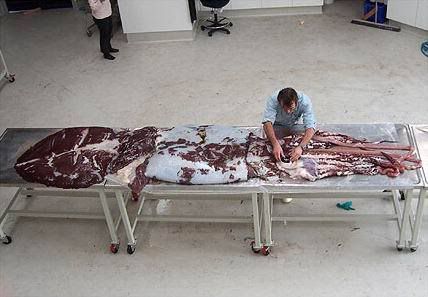
En abril del 2003 se obtuvo un calamar de la especie Mesonychoteuthis hamiltoni, al que han llamado "calamar colosal" para diferenciarlo del "calamar gigante" (Architeuthis dux). Esto fue en el Mar de Ross, parte de las aguas antárticas, y se trató del primer ejemplar de un M. hamiltoni que se ha recuperado intacto de la superficie del océano. El calamar estaba comiendo merluza negra, un pez que crece hasta dos metros de longitud, cuando fue capturado. Ya estaba muerto al ser subido a la embarcación y ahora se halla en el Museo Nacional de Nueva Zelanda.
Mesonychoteuthis hamiltoni en la mesa de estudio
El Dr Steve O'Shea, experto en calamares de la Auckland University of Technology, explicó que todo lo que se sabía de estos animales es que viven en el entorno abisal de la Antártida. Se sabe ahora que es capaz de subir hasta la superficie a través de la enorme columna de agua y que alcanza un tamaño espectacular.
El Mesonychoteuthis hamiltoni fue identificado por primera vez en 1925 luego de que se hallaron dos tentáculos en el estómago de un cachalote.
Sólo se han obtenido seis especímenes de este calamar: este animal completo y cinco tentáculos que se sacaron de los estómagos de cachalotes atrapados por redes de arrastre a profundidades de of 2.000 a 2.200 metros.
El doctor O’Shea dijo: "Ahora podemos decir que alcanza un tamaño mayor que el del calamar gigante, que ya no es el calamar más grande que hay. Hemos obtenido algo que es mayor, y no sólo algo más grande, sino de un orden de magnitud mayor."
Este calamar tiene uno de los picos más grandes que se conocen en los calamares y también posee unos ganchos únicos, que giran sobre un eje, en las mazas de los extremos de sus tentáculos.
Este calamar es veloz y más agresivo que el calamar gigante. Caza haciendo resplandecer sus ojos a fin de ver los brillos que desprenden sus presas.
El manto de este espécimen tenía 2,5 metros, y se estima que este tamaño es sólo la mitad de lo que puede crecer. Los tentáculos, más que nada los prensiles, se extienden mucho más, lo que hace tan grande la longitud total del animal.
Mesonychoteuthis hamiltoni en la mesa de estudio
El Dr Steve O'Shea, experto en calamares de la Auckland University of Technology, explicó que todo lo que se sabía de estos animales es que viven en el entorno abisal de la Antártida. Se sabe ahora que es capaz de subir hasta la superficie a través de la enorme columna de agua y que alcanza un tamaño espectacular.
El Mesonychoteuthis hamiltoni fue identificado por primera vez en 1925 luego de que se hallaron dos tentáculos en el estómago de un cachalote.
Sólo se han obtenido seis especímenes de este calamar: este animal completo y cinco tentáculos que se sacaron de los estómagos de cachalotes atrapados por redes de arrastre a profundidades de of 2.000 a 2.200 metros.
El doctor O’Shea dijo: "Ahora podemos decir que alcanza un tamaño mayor que el del calamar gigante, que ya no es el calamar más grande que hay. Hemos obtenido algo que es mayor, y no sólo algo más grande, sino de un orden de magnitud mayor."
Este calamar tiene uno de los picos más grandes que se conocen en los calamares y también posee unos ganchos únicos, que giran sobre un eje, en las mazas de los extremos de sus tentáculos.
Este calamar es veloz y más agresivo que el calamar gigante. Caza haciendo resplandecer sus ojos a fin de ver los brillos que desprenden sus presas.
El manto de este espécimen tenía 2,5 metros, y se estima que este tamaño es sólo la mitad de lo que puede crecer. Los tentáculos, más que nada los prensiles, se extienden mucho más, lo que hace tan grande la longitud total del animal.
Leer el artículo completo en Axxon: Monstruos en el mar
Labels: Monstruos marinos
Pulpo Gigante -Adopta un pulpo gigante!-
Published Sunday, May 14, 2006 by Spyder.
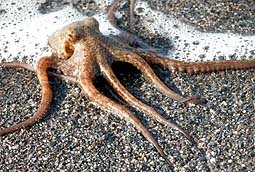 Si vas a Washington D.C podrás visitar el Zoo Nacional que depende del Instituto Smithsonian. El zoo tiene un programa de adopciones, por lo que no le será dificil adoptar uno de sus pulpos gigantes. Ahora, eso sí, usted no se lo podrá llevar a casa.
Giant Octopus—
Mighty but Secretive Denizen of the Deep
Adopt a Giant Octopus!
Adopt a Giant Octopus!
With its writhing tentacles and eerie ability to figure things out, the octopus is one of the strangest animals in the sea, or on Earth, for that matter. Its alien appearance and sliminess unnerve some people, offering plenty of material for nightmares and legends. Octopus stories abound around the globe, including seafaring yarns about huge, blood-thirsty “devilfish” tearing ships to bits. While these stories are usually debunked, the uncanny abilities and physique of the remarkable giant octopus make these tales hard to let go.
Large, but Short-Lived MolluskThe largest of at least 90 subspecies of octopus, the giant octopus can grow to 300 pounds and have a 30-foot arm span. However, mature males average only about 50 pounds and females, about 33 pounds. Their arm spans typically are about eight feet. Despite its fearsome appearance, the giant octopus—while quite resourceful—is very shy and poses little danger to divers, fishermen, or swimmers. These mollusks are distant relatives of garden snails and slugs, and closer relatives of squids and cuttlefish. The giant octopus can be found in the coastal waters of northern California through the Gulf of Alaska, and around the Pacific Rim to Japan and Korea. They live in waters just beyond the low-tide mark to depths of up to 1,500 feet along the continental shelf. They usually live about three to five years.
A giant octopus spends most of its day lurking in a rocky crevice, emerging at night to forage for prey. When it ventures out, it typically crawls along the sea floor, often with surprising speed. Above the floor, it propels itself by a water jet thrust out through its gill chamber.
A giant octopus eats almost anything it can catch, with crabs at the top of its list of favorites. It also catches fish and other octopuses. It hunts mainly by sight. The octopus surges forward and envelops prey with its strong tentacles. Its suckers have touch sensors and chemical receptors that it uses to check out its catch, allowing it to reject anything that feels or tastes wrong. Sometimes the octopus paralyses its victim with venom from its salivary glands, but usually it just rips prey apart with its powerful suckers. The octopus kills crabs with a shell-crushing bite from the parrot-like beak concealed at the center of its tentacles. It then scoops out the flesh and discards any shell outside its lair.
Male giant octopuses mature sexually before females. During mating, the male uses a specialized tentacle to insert a sperm packet into the female. The male dies soon after mating. The female produces up to 100,000 eggs, which she attaches to the ceiling of her den. She guards her eggs for six months, never eating or even leaving her den. She oxygenates her eggs by shooting water over them from her gills. Exhausted by breeding and starved by the vigil over her eggs, the female dies almost as soon as the eggs hatch. Each egg hatches into a tiny octopus about one-quarter of an inch long. Baby octopuses swim to the surface to live as plankton—tiny plants and animals that drift in the ocean—until settling on the seabed when about one-half ounce in weight where it grows at an amazing rate—reaching two to three pounds in one year and then continuing to gain about two percent of body weight per day! Few hatchlings, however, ever reach maturity before becoming food for fish, moray eels, sea lions, or other octopuses.
Intelligent Invertebrate?The giant octopus has the largest central nervous system—mostly brain—of all invertebrates, rivaling that of many vertebrates, including birds and fish. It can do some really amazing things. But is it intelligent? Herein lies much debate-fodder for scientists. The fact that octopuses survive despite being soft, tasty creatures suggests to some that they are resourceful and intelligent. They also appear quite capable of solving simple puzzles, learning, and remembering. Scientists have trained captive specimens to negotiate their way through simple mazes and distinguish squares from crosses. They have been taught to unscrew lids from food jars and have been observed learning by watching the behavior of other octopuses.
But other scientists aren’t so sure that big brains mean greater intelligence. They suggest that a big brain may be necessary to operate such a complex animal with sophisticated eyes, eight versatile tentacles, ability to change color, sensitive suckers.
Dazzling Array of Defensive and Offensive Weapons
Suckers. The octopus uses its suckers to rip prey apart and anchor itself to a rocky surface. Sensors around each sucker allow the animal to reject anything that tastes or feels wrong.
Tentacles. The octopus has eight strong arms capable of pushing, pulling, and grasping prey tightly.
Beak. The giant octopus uses its powerful beak to crush crab shells.
Venom. Venom in its salivary glands contains a chemical that helps the octopus disable prey and break down its muscle tissue.
Ink. The octopus can disorient a pursuer by squirting a burst of purplish-black ink.
Appendage Regeneration. Should the animal lose a tentacle to a predator, it can grow a new limb.
Camouflage. The octopus can change the color and texture of its skin cells in less than one second to blend in with its surroundings. These cells in its skin called chromatophores are under muscular control, allowing different pigments to come into view as the cell walls are stretched or squeezed. One expert suggests that “Chameleons are just dead-boring compared to octopuses.”
Giant Octo-Facts
A giant octopus can live out of water for some time as long as it stays cool and damp. It may leave the water to search for food on land. To snatch quick snacks, octopuses have been known to climb aboard fishing boats and open fish holds full of crabs or to break out of aquariums to prow around rooms for tasty inhabitants in other tanks. They generally have up to one-half hour out of water before they die from lack of oxygen.
Octopus blood is a poor carrier of oxygen. To compensate, these animals have three hearts and permanently high blood pressure. As a result of these physiological inefficiencies, the octopus has poor stamina and an inability to struggle offensively or defensively for very long.
By day giant octopuses retreat to dens under rocks or in holes. At the entrance, one typically observes an “octopus’s garden” composed of a collection of bones, spines, and shells from past meals.
An octopus can squeeze through an opening no bigger than one of its eyes.
An octopus’s brain continues to grow throughout the life of the animal and consists of over 170 million nerve cells, three-quarters of which are involved in vision.
Conservation StatusGiant octopuses are important members of the oceanic web of life. As hatchlings they enter the low end of the food chain—the diverse plankton soup—that feeds myriads of animals. As they grow to maturity, they climb to almost the top of the ocean’s food chain to become a formidable predator.
The giant octopus is currently not considered endangered, and some intrepid enthusiasts keep them as pets, although this requires a major commitment. The giant octopus is vulnerable to pollution, but unlike its edible relative, the common octopus, it is not in direct danger from humans even though there is a small commercial fishery for it from Alaska to Northern California, mainly as a bait for halibut fisheries. In Oregon, many octopus are taken as incidental catch in the Dungeness crab pot fishery and the groundfish trawl fishery. Octopus overfishing, however, appears to have occurred in Japan and in sport dive fisheries in the straits between Vancouver Island and mainland British Columbia.
Enriching an Octopus’s Life—the Zoo ExperienceThe National Zoo currently has a female giant octopus in residence at its Invertebrate Exhibit. It is a very popular animal at the Zoo mainly because, unlike many Zoo animals, the giant octopus is familiar to most visitors through stories. Also, adding to its appeal, the animal is large and gregarious, never missing an opportunity to react and interact. Few can resist the opportunity to look the octopus in the eye and have it stare back. One keeper calls the giant octopus “the Invertebrate Exhibit’s giant panda.” This popular mollusk is fed a diet of shrimp, fish, and crab.
To provide this fascinating animal opportunities for exploration and interaction similar to those observed in the wild, the Zoo has implemented an Octopus Enrichment Program. Under the watch of a trained observer, a new object—such as a jar, tube, or rubber dog toy—is introduced periodically to the octopus. With each introduction the animal's behavior is recorded to identify the level of interaction with the object. In addition, the tank contains shelves, archways, and doors. New objects and complexities are planned for the future to give this mollusk with a sophisticated brain a new and broader array of challenges.
Adopt a Giant OctopusWhy not consider adopting this wild and wonderful giant from the deep for yourself or for a special someone? An Adopt a Giant Octopus package would make an especially wonderful educational gift for a child. Your adopt contribution will support exhibit improvement, medical care, and food not only for the giant octopus but also for the more than 2,400 other animals that reside at the National Zoo and its Conservation and Research Center at Front Royal, Virginia.
Labels: Monstruos marinos
Pulpo gigante: el pez diablo
Published Friday, May 12, 2006 by Spyder.
 Los misterios del mundo animal , Pulpo Gigante: el pez diablo
 Ricardo Santiago Katz (*)
rskatz4@hotmail.com
En la Isla canadiense de Vancouver habitan pulpos de aproximadamente 50 kilos de peso.
Sobre el puente de la pequeña embarcación, inmóvil en la costa de Victoria, en la isla canadiense de Vancouver, todo está listo para iniciar la inmersión e ir al encuentro del escurridizo pulpo gigante, o lo que es lo mismo, el octopus dofleini, una bestia cuyos machos pueden alcanzar los 50 kilos de peso y las hembras unos 30 kilos.
Cosgrove, investigador del Royal British Columbia Museum Victoria, que desde hace 28 años estudia los pulpos del estrecho de Juan de Fuca, conjuntamente con el fotógrafo Jeff Rotman, se zambullen en las gélidas aguas de Race Rocks.
Mientras descienden a lo largo de las paredes rocosas escrutan en las hendiduras de la escollera buscando los posibles escondites del pulpo. Sobre el fondo del mar, 25 metros bajo la superficie, un grupo de conchas vacías, como si fuera una “X” trazada sobre el mapa de un tesoro, señalan la entrada de la guarida.
Los estudiosos saben que hacerlo salir es tan difícil como peligroso. Con sus ocho tentáculos, podría mover con facilidad 300 kilos. Para lograr sacarlo, se rocía en la guarida una sustancia química inocua que molesta al animal que, poco a poco, se asoma desde su refugio y comienza a investigar con los tentáculos que o quien osa interrumpir su tranquilidad.
Los órganos sensoriales de los pulpos llamados mio-receptores, se encuentran en los bordes de las ventosas. Con ellos fijan las características físicas y el sabor de cuanto los rodea, sobre todo de sus presas. Tanto es así, que los pulpos tienen la nariz al final de los brazos.
El pulpo capturado se trata de un ejemplar adulto, con unos tentáculos de alrededor de dos metros y medio y un peso de 32 kilos. Es un macho, lo que se reconoce fácilmente, por la punta en forma de cuchara que posee en la parte final derecha de su tercer tentáculo. Esta punta, conocida como hectocotylus, es su órgano sexual.
Durante 28 años he vigilado atentamente las idas y venidas de los pulpos, cuenta Cosgrove que: “sus escaramuzas sexuales, los nacimientos y las muertes. Son animales reservados, gentiles y fascinantes. Te exploran y te confunden, pero no muerden. Antes que molestar, prefieren irse de puntillas con sus tentáculos”
En el transcurso de sus investigaciones ha descubierto que las hembras prefieren permanecer en el mismo lugar durante la puesta de los huevos -el récord está en 202 días-, mientras que los machos se trasladan más rápidamente para encontrar nuevas compañeras.
Los pulpos también tienen inclinación a ocupar el mayor número de guaridas libres. Apenas muere o se marcha un ejemplar, otro de dimensiones similares ocupa su puesto.
Como otros animales, los pulpos tienen su territorio de caza y se mueven dentro de un cuadrado de, aproximadamente, 140 metros de lado en sus partidas de caza, pero no agreden a sus congéneres.
Un pulpo no intenta entrar en la guarida de otro de un tamaño similar para comérselo, para expulsarlo u ocupar su puesto. En todo caso prefieren ponerse de acuerdo.
Los ejemplares mayores, por el contrario, se comen a los menores, y esto puede explicar la razón por la cual solamente los pulpos de una misma talla y edad viven cerca.
Se ha descubierto que los pulpos no son cazadores, exclusivamente, nocturnos. Esta conclusión ha derivado de un experimento llevado a cabo por los investigadores, después de haber acoplado pequeños emisores de ultrasonido a varios ejemplares, siguiendo sus movimientos durante tres semanas.
Para capturar a sus presas, los pulpos utilizan la vista y el olfato, ambos muy desarrollados. Pero, mientras que el hombre tiene los ojos situados dentro del cráneo, el elástico pulpo puede girarlos 180 grados simplemente elevando la piel de la cabeza.
Generalmente, un pulpo hembra puede traer al mundo hasta 50.000 pequeños, pero son muy pocos los que logran sobrevivir el tiempo suficiente para reproducirse. Los huevos eclosionan de noche, pero los depredadores los descubren muy pronto, el 90 % de los nacidos son devorados en su primera hora de vida por los cangrejos y los peces.
Estos animales no han sido puestos en peligro por el hombre pero, junto a otros cefalópodos como la sepia y los calamares, parecen destinados a desaparecer -en términos evolutivos- porque la mayor parte de ellos no tienen suficientes dotes para la supervivencia a los cambios ambientales.
(*) Licenciado en Ciencias de la Educación y escritor bonaerense
Labels: Monstruos marinos
Pulpo gigante de Hawai
Published Thursday, May 11, 2006 by Spyder.
El pulpo gigante es un monstruo bastante común en el folklore de las islas del Pacífico: Hawai, las islas Cook... Hawaii, como las Bermudas, es un archipiélago volcánico rodeado de aguas profundas.
Se han publicado dos testimonios de avistamientos de pulpos gigantes en el archipiélago hawaiano en los años 1950. Según las descripciones, los brazos, de más de veinte metros de longitud, estaban cubiertos de grandes ventosas, lo que puede indicar que se trata de pulpos incirrados, a diferencia del pulpo gigante de las Bahamas. Además, los lugares donde se observaron los pulpos son semejantes: En los dos casos se trataba de zonas poco profundas cercanas a lugares de anidamiento de tortugas marinas. Pero, desde entonces, no se han vuelto a tener noticias.
Se han publicado dos testimonios de avistamientos de pulpos gigantes en el archipiélago hawaiano en los años 1950. Según las descripciones, los brazos, de más de veinte metros de longitud, estaban cubiertos de grandes ventosas, lo que puede indicar que se trata de pulpos incirrados, a diferencia del pulpo gigante de las Bahamas. Además, los lugares donde se observaron los pulpos son semejantes: En los dos casos se trataba de zonas poco profundas cercanas a lugares de anidamiento de tortugas marinas. Pero, desde entonces, no se han vuelto a tener noticias.
Labels: Monstruos marinos
Pulpo gigante de las Bermudas
Published by Spyder.
En las Bermudas, archipiélago volcánico rodeado de fondos oceánicos profundos, se han recogido diversos testimonios que señalan la existencia de un animal parecido al lusca. En 1969, dos submarinistas observaron una especie de pulpo o medusa pulsátil de quince metros de diámetro y de veinte a treinta de longitud. En 1984, John P. Ingham, un pescador de crustáceos, perdió dos nasas de varios metros cúbicos llenas de cangrejos Geryon a unos novecientos metros de profundidad. Poco después, estuvo a punto de perder una tercera nasa: Un animal, identificado con el sonar como una masa piramidal de 15 metros de altura, remolcó el barco, de 15 metros de eslora, durante varios cientos de metros a 2 kilómetros por hora. En 1985, el mismo pescador observó un pulpo gigante agarrado a una de sus nasas, del que pudo cortar un fragmento de veinte kilos de consistencia gelatinosa. Por último, en 1988, apareció en la playa de Mangrove Bay una masa de colágeno inodora de 2,4 metros de longitud, con la consistencia del caucho, similar al cadáver de Saint Augustine; los análisis realizados indican que no son los restos de un mamífero marino.
Se trata seguramente de un animal diferente del lusca, puesto que su biotopo es también diferente. Además, las Bermudas se encuentran separadas de las Bahamas por la llanura abisal de Hatteras, de más de cuatro mil metros de profundidad, una barrera infranqueable para los animales bentónicos, como los pulpos.
Raynal ha propuesto para esta especie el nombre de Geryonoctopus inghami.
Conviene tener presente que tanto el aspecto gelatinoso como el movimiento pulsátil observados son comunes en varias familias de pulpos.
Labels: Monstruos marinos
Pulpo gigante de las Bahamas
Published Wednesday, May 10, 2006 by Spyder.
Las islas Bahamas son los puntos culminantes de una llanura caliza submarina de poca profundidad. Esta llanura está salpicada de grutas producidas por la erosión durante la última glaciación, cuando el nivel del mar era más bajo que en la actualidad y la llanura formaba parte de la tierra firme. El derrumbamiento del techo de esas grutas submarinas ha dado lugar a una formación geológica típica de la región, los blue holes (pozos azules); son el equivalente submarino de las dolinas del relieve cárstico, también llamadas cenotes en el Yucatán. Es un biotopo perfecto para un pulpo gigante. Curiosamente, es en esta misma región donde Julio Verne situó el combate de la tripulación del Nautilus con el pulpo gigante en "Veinte mil leguas de viaje submarino".
Pues bien, según los pescadores de las Bahamas (sobre todo de la isla Andros) y las vecinas islas Caicos, los blue holes son la guarida de un enorme monstruo marino, llamado lusca, him of the hairy hands ("el de las manos peludas") o giant scuttle (pulpo gigante). Es tan temido que los pescadores se niegan a acudir de noche a los blue holes. Resulta revelador que el vocablo scuttle, que en las Bahamas designa al pulpo y se supone derivado de cuttlefish (sepia), también significa "echar a pique".
Para algunos, el lusca no es más que una personificación de las peligrosas corrientes y remolinos habituales en los blue holes, pero existen, como veremos, testigos directos y pruebas materiales de la existencia de este monstruo marino.
Del estudio de los testimonios de pescadores, marinos, submarinistas (entre ellos el célebre comandante Cousteau) y científicos, recogidos en la región desde el siglo XIX, Raynal concluye que el lusca es un pulpo cuyo cuerpo alcanza seis metros de longitud y nueve de diámetro. En cuanto a los brazos, de aspecto peludo y hasta treinta centímetros de grosor, sobrepasan los veinte metros de longitud; aparentemente, están desprovistos de ventosas, o bien éstas sólo están presentes en los extremos. Su peso se estima en unas veinte toneladas. El color de la piel es pardusco, aunque puede cambiar cuando el animal se excita. Posiblemente está dotado de órganos luminiscentes. No puede ser un calamar gigante, puesto que es capaz de trepar a la cubierta de los barcos, una acción imposible para un decápodo debido a la rigidez de su cuerpo.
El 30 de noviembre de 1896, se encontró varado en una playa de la isla Anastasia (12 millas al sur de Saint Augustine, en la costa este de Florida) el cadáver mutilado en descomposición de un gran animal. De color rosa pálido, casi blanco (probablemente despigmentado), su carne tenía una consistencia muy dura, lo que la hacía muy difícil de cortar. El cuerpo, de 6 metros de largo, 5 de ancho y 1,2 de altura, pesaba varias toneladas, y poseía varios muñones de brazos de 25 centímetros de grosor, uno de los cuales medía casi diez metros. Según el doctor DeWitt Webb, fundador y presidente de la Saint-Augustine Scientific, Literary and Historical Society, que fue el único científico que pudo estudiar directamente el cadáver, se trataba de un pulpo: la ausencia de esqueleto, la pequeñez de los escasos órganos internos que quedaban y la estructura muscular del cuerpo eran todas características de un octópodo. El profesor Addison Emery Verrill (1839-1926), zoólogo de la Universidad de Yale y autoridad mundial en cefalópodos, le atribuyó un peso total, en vida, de unas veinte toneladas, y una envergadura de cincuenta a sesenta metros; lo bautizó con el nombre de Octopus giganteus en el American Journal of Science en 1897, aunque poco después se retractó y afirmó que se trataba de los restos de un cachalote.
Otro detalle que indica que se trataba de un cefalópodo, y no de un cetáceo, es que a lo largo de los meses durante los que los restos permanecieron varados, prácticamente no se produjo putrefacción. Tras varios intentos, resultó imposible conservar el gigantesco cuerpo que, con el tiempo, debió ser arrastrado de nuevo por el mar. En la actualidad, solamente se conservan unas pequeñas muestras en la Smithsonian Institution.
Recientes análisis histológicos de estos fragmentos, publicados en Natural History en 1971 por Joseph F. Gennaro Jr., biólogo de la Universidad de Florida, y Forrest Glenn Wood, especialista en biología marina del Naval Undersea Research and Development Laboratory de San Diego; y bioquímicos, publicados por Roy P. Mackal en Criptozoology en 1986, confirmaron la identificación del pulpo gigante: se trata de tejido de cefalópodo, y no de mamífero.
En 1995, Sydney K. Pierce, Timothy K. Maugel y Eugenie Clark, de la Universidad de Maryland, y Gerald N. Smith Jr., de la de Indianápolis, realizaron nuevos análisis y concluyeron que los fragmentos corresponden a la piel de un cetáceo, pero Raynal ha demostrado, en Of Sea and Shore (1996), que los resultados de esos análisis confirman por el contrario la tesis del pulpo: El hecho de que los tejidos analizados están formados por colágeno casi puro, la composición bioquímica de este colágeno y la ausencia de grasas son incompatibles con la hipótesis del cetáceo.
Varios motivos han inducido a Raynal a suponer que este pulpo gigante pertenece al suborden de los cirrados. En primer lugar, las "manos peludas" del lusca. También la ausencia de ventosas en el cadáver de Saint Augustine y la presencia de dos muñones en una posición que se corresponde más con la de las aletas de los pulpos cirrados que con la de los brazos. Y por último, la frecuente confusión en los testimonios visuales entre pulpo y calamar: Los pulpos cirrados, de costumbres menos sedentarias que los incirrados (más conocidos, sobre todo por sus aplicaciones culinarias), son más semejantes a los calamares en anatomía y comportamiento. Si esta identificación es correcta, el nombre propuesto por Verrill, Octopus giganteus, no es válido, puesto que el género Octopus pertenece al suborden de los incirrados. Raynal ha propuesto el nombre Otoctopus giganteus.
Existen testimonios similares, aunque más escasos, fuera de las Bahamas y las Caicos: en Cuba y en la península de Yucatán, donde se ha atribuido a los pulpos gigantes la muerte de dos personas, atacadas en sus piraguas. La geología y la ecología submarina de esta última región son muy similares a las de las Bahamas. Existe también un informe aislado de Tejas. En la costa de Florida, sin embargo, aparte del cadáver de Saint Augustine, sólo se cuenta con el testimonio de la tripulación del U.S. Chicopee A0-41, que en 1941 observó un enorme pulpo muerto flotando cerca del barco; ambos cadáveres pudieron haber sido arrastrados por la corriente marina de Florida, que recorre la costa sureste de los Estados Unidos, desde las Bahamas hasta el cabo Hatteras, en Carolina del Norte.
Estos pulpos viven en las cuevas submarinas a menos de 300 metros de profundidad, de las que salen, principalmente por la noche, para alimentarse. La base de su dieta debe de ser la langosta Panulirus argus, muy abundante en la región, y que puede alcanzar un metro de longitud y cinco o diez kilos de peso; además de otros crustáceos, moluscos y peces. Su comportamiento territorial les hace atacar e incluso trepar a los barcos que se acercan a sus guaridas. En varias ocasiones se ha constatado que son capaces de cortar los sedales más resistentes, incluso de acero, después de inmovilizarlos durante varios minutos.
Labels: Monstruos marinos
Pulpo gigante -In the Octopus's Garden-
Published Tuesday, May 09, 2006 by Spyder.
Un artículo muy interesante sobre la investigaciones del pulpo gigante del pacífico, en la web que mantiene Nurp (NOAA's Undersea Research Program). La NOAA es la National Oceanic and Atmospheric Administration de los EEUU.
In the Octopus's Garden
by Julie Zeidner Russo
by Julie Zeidner Russo
The sighting of fantastic sea creatures like the giant octopus have been portrayed throughout history. Probably the first recorded mention of something that resembles an octopus was the monster Scylla in Homer's Odyssey. At the dawn of a new millennium, the giant octopus is not so much a folkloric figure as a culinary delicacy for the Japanese, a staple in some Native American diets, and a subject of rare scientific scrutiny.
There is still much to learn about the giant octopus beyond its role in fiction or as a food source. Taste for the giant octopus could make it subject to an eastern Pacific commercial fishery before long. This increasing demand comes well in advance of an understanding of how and where the giant octopus lives.
A wealth of information on what is known about the giant octopus can be found at marine ecologist David Scheel's web site at http://www.pwssc.gen.ak.us/~dls. Reading through the site, one learns a great deal about the largest species of octopus in the world known as Enteroctopus dofleini. Although the giant octopus rarely weighs more than 100 pounds (45 kg), a few large individuals have been recorded up to 400 pounds (182 kg). While there are more than 100 species of octopuses in the world, our knowledge of octopuses comes almost entirely from a few species, Scheel said.
An intensive effort to learn more about the giant octopus commenced after the Exxon Valdez oil spill impacted the area. The Prince William Sound Science Center (PWSSC), a nonprofit research institute where Scheel is an associate scientist, was established in response to the environmental disaster.
The institute's focus would be on ecological research associated with the Prince William Sound and Copper River Watersheds in Alaska. Their work would be important since the Sound is one of the last major glacial carved embayments on the northwestern edge of a temperate coastal zone with rainforest biodiversity. "It's a really amazing area with a very complex history of coastal peoples," Scheel said.
A coastal tradition was upset following the 1989 oil spill. The native villagers in Tatitlek and Chenega Bay eat amikuq (the Alutiiq word for octopus) as part of their subsistence lifestyle. They reported that octopuses became scarce in the years following the 1989 oil spill, Scheel said. A two-year study was launched by Scheel and co-investigators to survey octopuses from the shoreline to 30 feet. The study was paid for by the Exxon Valdez Oil Spill Trustee Council. The researchers adopted the technique used by native villagers when harvesting octopus that den under rocks and are exposed at low tide as a means of counting and characterizing octopuses. They found densities an order of magnitude--10 to one--less than a survey done in British Columbia by scientist Brian Hartwick in the '70s and early '80s, Scheel said. Researchers did not have enough information about the giant octopus to attribute this difference to the more northern study area in Prince William Sound, or to a decline in abundance from man-made causes or from natural fluctuations in abundance. "It's not clear there was any decline in octopuses," said Scheel, noting more research would have to be done to determine if there was a problem.
In 1996, researchers used SCUBA dives to further investigate where and how the octopus lives and moves, and what it eats. They tagged individuals with sonic tracking devices, and monitored their movements. "SCUBA surveys proved that octopuses were more abundant on shallow dives (to five m.) than on deep dives," Scheel said. The researchers also found an abundance of juvenile octopuses, and very few adults. Where had they gone? To determine whether depth is significant in the ecology of the giant octopus researchers would need to dive deeper.
The chance to go deeper in search of the adult giant octopus occurred in May of 1998. This would be the first time researchers ever provided descriptions of octopus habitat below SCUBA depths. Scheel and ecologist Tania Vincent, also of the PWSSC, made 27 dives in the Delta submersible with support from the NOAA's Undersea Research Program (NURP).
"Using the submersible, we were able to go down and find octopuses too small to be caught by pots or long-line," Scheel said, "as well as survey the habitats, the predators, and the prey base." Scheel and Vincent would conduct 20 1000 m long transect surveys, three dives tracking a sonic-tagged octopus, and four dives to resurvey areas explored during the earlier SCUBA research and other sites of interest.
Giant octopuses have a unique life history that is only partly understood. They live across the broad continental shelf of the north Pacific ocean in a range extending from southern California to the Pacific Northwest, across the Aleutians, and south to Japan, Scheel said. They exist in shallow waters to 200 m, and may occur deeper. What happens to them during their short life span of three to five years is not fully known.
Females lay as many as 100,000 eggs inside of a rocky den and tend to them. "They senesce and die at about the time the eggs hatch," Scheel said. The males, who move around during the mating period, also die a few months later. On hatching, baby octopuses enter the plankton till they get big enough to settle down to the bottom again. After settlement, dens are an important resource for the octopus. Dens are not only used by the females for tending to their eggs, but serve as a place to hide from other predators.
"Marine mammals that feed on octopuses include seals, sea lions, sea otters, and killer whales, at least," Scheel said. Their dens-nicknamed the Octopus's Garden-also reveal a lot about them. Researchers study the middens or refuse heaps outside the octopus den to learn more about their diets, which include crustaceans, small crabs, scallops, bivalves, snails, fish, and even other octopuses.
Prior to the NURP study, the researchers understanding of the ecology of the giant octopus in rocky habitats of the eastern Pacific came from surveys to 30 m. Determining the abundance of octopuses below 30 m would be a key part of this study. Researchers theorized that since octopuses were nearly absent from depths between 10 and 30 m. in Prince William Sound, but abundant in shallower waters, that the very shallow areas might be important rearing habitat, Scheel said. They would need data from deeper areas to compare. There also appeared to be an abundance of octopuses living in heavy kelp beds in shallow areas, which may provide shelter from predators. "We thought octopuses may be restricted by high predation risk from using habits at intermediate depths to 40 meters," Scheel said. "If this were true, we anticipated that larger octopuses would be more common in deeper water; and that there might be more octopuses of all sizes."
What researchers discovered puzzled them. During the Delta dives from10 to 200 meters, Scheel and Vincent only found a total of 19 octopuses and only one was of adult size. "Contrary to our expectations, we found that larger octopuses were rare at any depth," Scheel said, "and although we found octopuses at all depths to 200 m, we found no indication of greater numbers of octopuses as we went deeper." However, they did note changes in the denning habits and diets of the octopuses at greater depths.
In order to manage the octopus fishery, resource managers will have to learn more about the natural fluctuations in octopus populations. Japan already has a large commercial fishery for octopus. While no commercial east Pacific fishery exists yet, interest is growing in developing one by parties in Japan, Africa, Greece, Alaska, and British Columbia.
"Fisheries scientists believe it would only take small changes in market demand for octopuses to trigger an increased commercial fishing effort," Scheel said. "This creates a possibility of over-exploitation of the stock, a matter of particular concern in the Gulf of Alaska coastal areas in light of damage to octopus habitat during the Exxon Valdez oil spill in 1989 and the subsistence harvests of octopuses by native peoples."
Centuries later, the giant octopus still has the capacity to intrigue us, but whether it can endure time before it is fully understood is questionable. There must have been other giant sea creatures that existed long ago that would have certainly marveled us today had they not perished. This makes understanding great animals that we know exist like the giant octopus seem all the more precious, if not critical. "The solitary nature and excellent camouflage abilities of the octopuses make them hard to count," Scheel said. While this helps protect them against natural predators, it makes it difficult for fisheries managers to conduct stock assessments to determine how they are faring and how they might be properly managed.
"Managers are considering whether an assessment based on mapping suitable habitat would provide a means to assess the population," Scheel said. "However, even habitat mapping is limited by our understanding of octopus habit ecology. This research should improve what is known about the giant octopus, so that enough information is available to prevent octopuses from being overexploited as a fisheries resource.
También recomiendo visitar al respecto la página The Giant Octopus Web Page
Labels: Monstruos marinos
Octopus giganteus
Published by Spyder.
Via Anomalies 101
Mike Tatzel
The object that started the commotion was a rotting carcass of great size. It was first seen by Herbert Coles and Dunham Coretter on a bicycle trip on the evening of November 30, 1896. The following event could have been of extreme zoological importance. What was instead ignored and ridiculed could have been one of the greatest zoological discoveries in history.
When the young men first saw the carcass, it had sunk into the sand because of its immense weight. The next day, Dr. DeWitt Webb, founder of the St. Augustine Historical Society and Institute of Science, arrived on the scene. The skin was of an extremely light pink color with a silvery tint to it. They concluded it weighed roughly five tons and the visible portions were twenty-three feet in length, four feet high, and eighteen feet across the widest part of the back. Webb, decided that it was not a whale but only some kind of octopus.
Mike Tatzel
The object that started the commotion was a rotting carcass of great size. It was first seen by Herbert Coles and Dunham Coretter on a bicycle trip on the evening of November 30, 1896. The following event could have been of extreme zoological importance. What was instead ignored and ridiculed could have been one of the greatest zoological discoveries in history.
When the young men first saw the carcass, it had sunk into the sand because of its immense weight. The next day, Dr. DeWitt Webb, founder of the St. Augustine Historical Society and Institute of Science, arrived on the scene. The skin was of an extremely light pink color with a silvery tint to it. They concluded it weighed roughly five tons and the visible portions were twenty-three feet in length, four feet high, and eighteen feet across the widest part of the back. Webb, decided that it was not a whale but only some kind of octopus.
Over the course of the next few days, Webb and the rest of the party returned and photographed the creature. Sadly those photographs were lost. However, two drawings based on the snapshots were made by A. Hyatt Verrill, son of Dr. Verrill. One assistant reportedly found fragments of arms while digging in the sand nearby. He was unfortunately alone at the time so his statement is uncorroborated. Evidently, it was attacked while still in the sea and had been dismembered before the carcass washed to shore. Soon afterwards, a storm dragged it out to sea where it again washed ashore two miles to the south of its original position.
It was then that Webb sent several letters describing the carcass to scientists. Professor Verrill of Yale read one of them. Verrill, a zoologist, was recognized for his work on cephalopods, especially giant squid. In a note in the American Journal of Science, published January 1897, he concluded the animal was a giant squid, not an octopus, but much larger that the Newfoundland specimens he had examined. Webb then forwarded more photographs and information to Verrill, who changed his theory to an octopus. He wrote more notes to the American Journal of Science describing the new giant octopus. He concluded the specimen’s tentacles to be approximately seventy-five to one hundred feet long by eighteen inches at the base. He then designated the new creature Octopus giganteous verrill, after himself.
It would be into the second week of January that the work on the specimen would continue. The carcass had been washed out to see again resulting in further losses of body parts and mutilation of the carcass. He reported to both Verrill and Professor William Healy Dall, curator of mollusks at the National Museum in Washington DC, now called the Smithsonian, by letter. In spite of this, neither Verrill nor Dall made any effort to investigate the carcass for themselves nor were they willing to provide the time and money to properly preserve the animal.
Using teams of horses and the efforts of local citizens and companies, Webb was able to move the carcass further up the beach. This protected the remains from being permanently washed out to sea where they would have been lost forever. He then prepared specimens for Verrill and Dall. They were both taken from the mantle of the creature and preserved in formaldehyde. This would turn out to be the only hard evidence to future scientists to study. Webb was, however, interested in preserving the whole carcass and preservatives were forwarded.
Verrill received Webb’s preserved specimen on February 23 and wrote letters of reaction that were published in Science on March 5, 1897, and in the Herald on the seventh. He described the samples visually and concluded they could not be octopus tissue because they resembled the blubber found in some crustaceans, despite the fact that little oil was found in them. Professor Frederic Augustus Lucas, of the National Museum, also examied the speciems and stated "the substance looks like blubber, and smells like blubber, and it is blubber, nothing more nor less."
Verrill finally concluded, after further examination of the tissues, that the bag-like section of the carcass was most likely the upper head and nose of a sperm whale. In the issues of the American Journal of Science and the American Naturalist for April, he does not try to make the objections and problems with his sperm whale theory less obvious. He pointed out that other zoologists that examined the carcass still believe it is an unknown cephalopod related to the octopus.
No work was done on the specimen until 1957 when Dr. F. G. Wood became interested and involved Dr. Joseph F. Gennaro Jr. Gennaro made a trip to the Smithsonian to collect the specimen and wrote:
There by the sink was a glass container about the size of a milk can. Inside it was a murky mixture of cheesecloth, formalin (and I think some alcohol), and half a dozen large white masses of tough fibrous material, each about as large as a good sized roast. We lifted them up with the cheesecloth, then took them out with forceps.
He noted that the material corresponded to Webb’s description. He was allowed to remove what he wanted with a dissecting knife with replaceable blades. The two pieces he removed were wrapped in cheesecloth, placed in a jar, and transported by himself to his laboratory.
Initial examination proved disappointing. There were no features such as suckers, identifiable skin structures, or muscular masses. He then viewed them through a microscope along with control specimen samples of known octopus and squid. He was disappointed to find no cellular fine structure. He expected highly differentiated cells of a mammal if it was from a whale or structures typical of a squid or octopus. Then he viewed his control samples. They also revealed little if any cellular structure. Differences of connective tissues were more striking. Octopus tissue was different from squid tissue and neither could be mistaken for mammalian tissue.
Using polarized light, Gennaro decide to compare connective tissues. His findings were as follows:
Now differences between the contemporary squid and octopus samples became very clear. In the octopus, broad bands of fibers passed along the plane of tissue and were separated by equally broad bands arranged in a perpendicular direction. In the squid there were narrower, but also relatively broad, bundles arranged in planes of the section, separated by thin partitions of perpendicular fibers….It seemed I had found the means to identify the mystery sample after all. I could distinguish between octopus and squid, and between them and mammals, which display a lacy network of connective tissue fibers….After seventy-five years, the moment of truth was at hand. Viewing section after section of the St. Augustine sample, we decided at once and beyond any doubt, that the sample was not whale blubber. Further, the connective tissue pattern was that of broad bands in the plane of the section with equally broad bands arranged perpendicularly, a structure similar to, if not identical with, that in my octopus sample….The evidence appears unmistakable that the St. Augustine sea monster was in fact an octopus, but the implications are fantastic.
We can agree with the assessment but should not be surprised that giant octopi have not been verified before. Perhaps the giant sucker marks on whales, particularly sperm whales, are not caused by giant squid, but rather by giant octopus, as they are more sluggish and are bottom dwellers. Where would these creatures be found? Wood’s investigations revolved around the Bahamas, where reported creatures known as the Lusca very clearly resemble that of giant octopi.
Interestingly enough, Wood had worked in the area in 1956, surveying possible sites for Marine Studios. At one point he recounted vague references to "giant scuttles." "Scuttle" is the Bahamian word for octopus. A reliable guide with whom he worked, named Duke, maintained that the scuttle’s arms were about seventy-five feet long. He also said they are not dangerous to fishermen unless they can grip the ocean floor and the boat at the same time. Additional information was received by George. J. Benjamin, who was intrigued by the great blue holes in the ocean floor around the Andros Islands. He nor his colleagues ever observed any octopi or squid on their investigations of the holes.
However, it seems that evidence presented, consisting not only of reports but also tissue samples, establishes that very large octopi exists somewhere in the Atlantic off the Florida coast. Whether these creatures explain the Lusca cannot be determined until deep diving exploration is carried out in the area.
It seems that other carcasses besides the now famous St. Augustine monster have been observed. In fact, many references can be found to unidentified sea creatures, dubbed globsters, that have washed ashore, some of which resemble the giant octopus. One such body found in Tasmania in August 1960 may have been another octopus. Unfortunately, the investigation that followed was worse than that for the St. Augustine carcass. The discovery was made by a rancher and two cowhands but did not reach the capital until months later. An aerial search located it and a four-man expedition was dispatched in March 1962 led by Bruce Mollison from the Commonwealth Scientific and Industrial Research Organization. They described the hairy carcass as having no eyes or bones and having creamy, rubbery skin. It was marked with what may have been gill slits. It was given headline treatment and even discussed in Parliament. A zoological team was sent by the government to investigate and returned the next day. Because of the time it had spent decomposing on the beach they said:
"…it is not possible to specifically identify it from our investigations so far. But our investigations lead us to believe that the so-called monster is a decomposing portion of a large marine animal. It is not inconsistent with blubber."
Mollison did not swallow their solution as easily as the press. He claimed they had to say it was ordinary to cover up the fact they were not fast enough to be able to investigate properly. What he saw was not part of a whale, he stated. Theories about the classification of the lump of flesh ranged from a thawed mammoth from Antarctic ice to a space-being. A.M. Clark from the University of Tasmania thought it might have been a giant ray.
Surprisingly, the same rancher who had first seen the Tasmanian globster stumbled across another carcass in 1970. He was in no way excited about it, remembering the ridicule he had gone through the first time. Hardly anyone rushed to investigate the carcass that could have put an end to the mystery of the 1960 carcass.
Other globsters include one that, in March 1965, washed up on the eastern shore of North Island in New Zealand. It was hairy, thirty feet long and eight feet tall. No other significant information was published. On Mangrove Bay beach in Bermuda in May 1988, tissue samples were taken of which laboratory results have yet to be released. Its discoverer, Teddy Tucker, described it as "three feet thick…very white and fibrous…with five arms or legs." Its flesh was extremely hard to cut even in the absence of bone. More recent globsters include that which was found on Four Mile Beach, Tasmania, in 1997. DNA testing was to be done but the results of those tests have never been published.
Marine biologists have turned their attention to those animals living in the unexplored ocean depths, where giant squid are believed to exist. Perhaps there is a bright future and possible discovery of the great octopus.
It was then that Webb sent several letters describing the carcass to scientists. Professor Verrill of Yale read one of them. Verrill, a zoologist, was recognized for his work on cephalopods, especially giant squid. In a note in the American Journal of Science, published January 1897, he concluded the animal was a giant squid, not an octopus, but much larger that the Newfoundland specimens he had examined. Webb then forwarded more photographs and information to Verrill, who changed his theory to an octopus. He wrote more notes to the American Journal of Science describing the new giant octopus. He concluded the specimen’s tentacles to be approximately seventy-five to one hundred feet long by eighteen inches at the base. He then designated the new creature Octopus giganteous verrill, after himself.
It would be into the second week of January that the work on the specimen would continue. The carcass had been washed out to see again resulting in further losses of body parts and mutilation of the carcass. He reported to both Verrill and Professor William Healy Dall, curator of mollusks at the National Museum in Washington DC, now called the Smithsonian, by letter. In spite of this, neither Verrill nor Dall made any effort to investigate the carcass for themselves nor were they willing to provide the time and money to properly preserve the animal.
Using teams of horses and the efforts of local citizens and companies, Webb was able to move the carcass further up the beach. This protected the remains from being permanently washed out to sea where they would have been lost forever. He then prepared specimens for Verrill and Dall. They were both taken from the mantle of the creature and preserved in formaldehyde. This would turn out to be the only hard evidence to future scientists to study. Webb was, however, interested in preserving the whole carcass and preservatives were forwarded.
Verrill received Webb’s preserved specimen on February 23 and wrote letters of reaction that were published in Science on March 5, 1897, and in the Herald on the seventh. He described the samples visually and concluded they could not be octopus tissue because they resembled the blubber found in some crustaceans, despite the fact that little oil was found in them. Professor Frederic Augustus Lucas, of the National Museum, also examied the speciems and stated "the substance looks like blubber, and smells like blubber, and it is blubber, nothing more nor less."
Verrill finally concluded, after further examination of the tissues, that the bag-like section of the carcass was most likely the upper head and nose of a sperm whale. In the issues of the American Journal of Science and the American Naturalist for April, he does not try to make the objections and problems with his sperm whale theory less obvious. He pointed out that other zoologists that examined the carcass still believe it is an unknown cephalopod related to the octopus.
No work was done on the specimen until 1957 when Dr. F. G. Wood became interested and involved Dr. Joseph F. Gennaro Jr. Gennaro made a trip to the Smithsonian to collect the specimen and wrote:
There by the sink was a glass container about the size of a milk can. Inside it was a murky mixture of cheesecloth, formalin (and I think some alcohol), and half a dozen large white masses of tough fibrous material, each about as large as a good sized roast. We lifted them up with the cheesecloth, then took them out with forceps.
He noted that the material corresponded to Webb’s description. He was allowed to remove what he wanted with a dissecting knife with replaceable blades. The two pieces he removed were wrapped in cheesecloth, placed in a jar, and transported by himself to his laboratory.
Initial examination proved disappointing. There were no features such as suckers, identifiable skin structures, or muscular masses. He then viewed them through a microscope along with control specimen samples of known octopus and squid. He was disappointed to find no cellular fine structure. He expected highly differentiated cells of a mammal if it was from a whale or structures typical of a squid or octopus. Then he viewed his control samples. They also revealed little if any cellular structure. Differences of connective tissues were more striking. Octopus tissue was different from squid tissue and neither could be mistaken for mammalian tissue.
Using polarized light, Gennaro decide to compare connective tissues. His findings were as follows:
Now differences between the contemporary squid and octopus samples became very clear. In the octopus, broad bands of fibers passed along the plane of tissue and were separated by equally broad bands arranged in a perpendicular direction. In the squid there were narrower, but also relatively broad, bundles arranged in planes of the section, separated by thin partitions of perpendicular fibers….It seemed I had found the means to identify the mystery sample after all. I could distinguish between octopus and squid, and between them and mammals, which display a lacy network of connective tissue fibers….After seventy-five years, the moment of truth was at hand. Viewing section after section of the St. Augustine sample, we decided at once and beyond any doubt, that the sample was not whale blubber. Further, the connective tissue pattern was that of broad bands in the plane of the section with equally broad bands arranged perpendicularly, a structure similar to, if not identical with, that in my octopus sample….The evidence appears unmistakable that the St. Augustine sea monster was in fact an octopus, but the implications are fantastic.
We can agree with the assessment but should not be surprised that giant octopi have not been verified before. Perhaps the giant sucker marks on whales, particularly sperm whales, are not caused by giant squid, but rather by giant octopus, as they are more sluggish and are bottom dwellers. Where would these creatures be found? Wood’s investigations revolved around the Bahamas, where reported creatures known as the Lusca very clearly resemble that of giant octopi.
Interestingly enough, Wood had worked in the area in 1956, surveying possible sites for Marine Studios. At one point he recounted vague references to "giant scuttles." "Scuttle" is the Bahamian word for octopus. A reliable guide with whom he worked, named Duke, maintained that the scuttle’s arms were about seventy-five feet long. He also said they are not dangerous to fishermen unless they can grip the ocean floor and the boat at the same time. Additional information was received by George. J. Benjamin, who was intrigued by the great blue holes in the ocean floor around the Andros Islands. He nor his colleagues ever observed any octopi or squid on their investigations of the holes.
However, it seems that evidence presented, consisting not only of reports but also tissue samples, establishes that very large octopi exists somewhere in the Atlantic off the Florida coast. Whether these creatures explain the Lusca cannot be determined until deep diving exploration is carried out in the area.
It seems that other carcasses besides the now famous St. Augustine monster have been observed. In fact, many references can be found to unidentified sea creatures, dubbed globsters, that have washed ashore, some of which resemble the giant octopus. One such body found in Tasmania in August 1960 may have been another octopus. Unfortunately, the investigation that followed was worse than that for the St. Augustine carcass. The discovery was made by a rancher and two cowhands but did not reach the capital until months later. An aerial search located it and a four-man expedition was dispatched in March 1962 led by Bruce Mollison from the Commonwealth Scientific and Industrial Research Organization. They described the hairy carcass as having no eyes or bones and having creamy, rubbery skin. It was marked with what may have been gill slits. It was given headline treatment and even discussed in Parliament. A zoological team was sent by the government to investigate and returned the next day. Because of the time it had spent decomposing on the beach they said:
"…it is not possible to specifically identify it from our investigations so far. But our investigations lead us to believe that the so-called monster is a decomposing portion of a large marine animal. It is not inconsistent with blubber."
Mollison did not swallow their solution as easily as the press. He claimed they had to say it was ordinary to cover up the fact they were not fast enough to be able to investigate properly. What he saw was not part of a whale, he stated. Theories about the classification of the lump of flesh ranged from a thawed mammoth from Antarctic ice to a space-being. A.M. Clark from the University of Tasmania thought it might have been a giant ray.
Surprisingly, the same rancher who had first seen the Tasmanian globster stumbled across another carcass in 1970. He was in no way excited about it, remembering the ridicule he had gone through the first time. Hardly anyone rushed to investigate the carcass that could have put an end to the mystery of the 1960 carcass.
Other globsters include one that, in March 1965, washed up on the eastern shore of North Island in New Zealand. It was hairy, thirty feet long and eight feet tall. No other significant information was published. On Mangrove Bay beach in Bermuda in May 1988, tissue samples were taken of which laboratory results have yet to be released. Its discoverer, Teddy Tucker, described it as "three feet thick…very white and fibrous…with five arms or legs." Its flesh was extremely hard to cut even in the absence of bone. More recent globsters include that which was found on Four Mile Beach, Tasmania, in 1997. DNA testing was to be done but the results of those tests have never been published.
Marine biologists have turned their attention to those animals living in the unexplored ocean depths, where giant squid are believed to exist. Perhaps there is a bright future and possible discovery of the great octopus.
Labels: Monstruos marinos


